Aldi vs Walmart vs Costco in 2026: Which Is Actually Cheapest for a Tariff-Proof Basket?
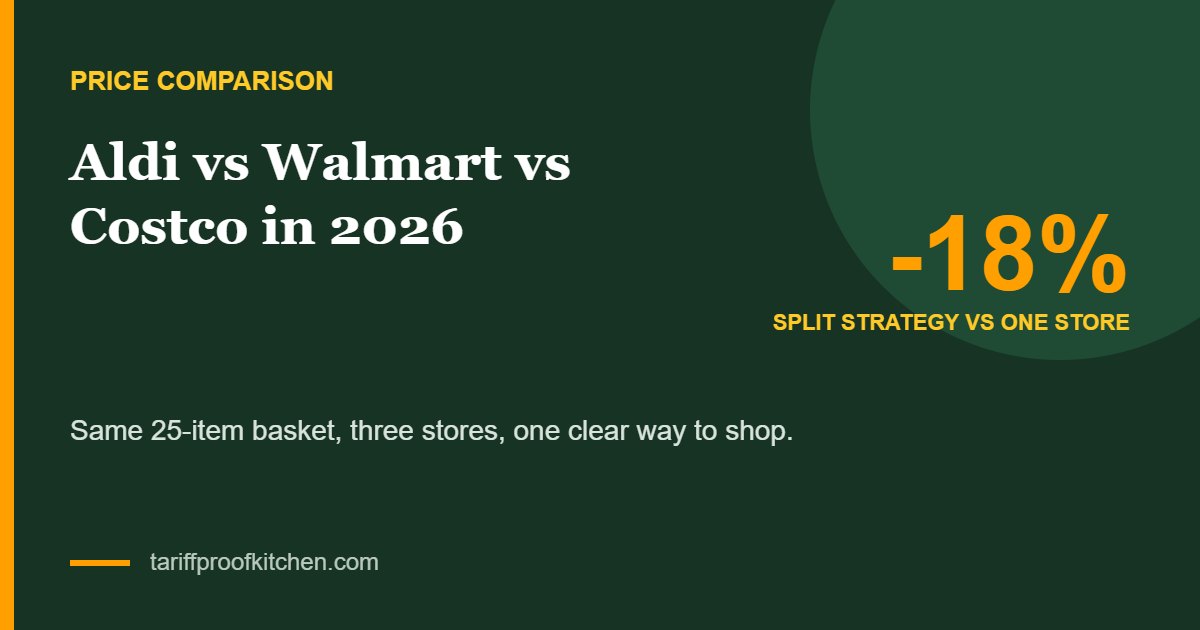
- Aldi is cheapest for the weekly basket: about 12% under Walmart and 9% under Costco on like-for-like items.
- Costco wins on bulk staples: rice, oil, coffee, canned tomatoes and frozen proteins by the case.
- Walmart is closest on average but rarely cheapest, and it wins on convenience and one-stop online orders.
- Splitting Aldi + Costco beats any single store by about 18%, roughly $110 a month on an $800 budget.
Every store-comparison article picks a basket that flatters its winner. Ours is deliberately boring: the 25 items a tariff-aware family of four actually buys most weeks, drawn from our tariff-proof grocery list. No organic, no specialty, store brand wherever one exists.
How we compared
Prices are typical shelf prices in mid-2026 for suburban US stores, normalised per unit so Costco's larger pack sizes do not distort the result. Where a store does not stock a like-for-like item, we used the nearest equivalent and flagged it. Prices move weekly; treat the percentages as the stable finding and the dollars as a snapshot.
The 25-item basket, priced
| Item (unit) | Aldi | Walmart | Costco* |
|---|---|---|---|
| Chicken thighs (per lb) | $1.69 | $1.98 | $1.79 |
| Eggs (dozen, large) | $2.45 | $2.72 | $2.30 |
| Ground turkey (per lb) | $3.29 | $3.68 | $3.15 |
| Dried black beans (per lb) | $1.19 | $1.38 | $0.95 |
| Long-grain rice (per lb) | $0.79 | $0.88 | $0.62 |
| Rolled oats (per lb) | $1.15 | $1.32 | $1.05 |
| Store-brand pasta (per lb) | $0.99 | $1.12 | $0.94 |
| Potatoes (per lb) | $0.59 | $0.74 | $0.68 |
| Bread (loaf) | $1.29 | $1.48 | $1.55 |
| Flour (per lb) | $0.49 | $0.56 | $0.44 |
| Frozen mixed vegetables (per lb) | $0.99 | $1.18 | $0.92 |
| Frozen berries (per lb) | $2.49 | $2.98 | $2.25 |
| Bananas (per lb) | $0.49 | $0.56 | $0.55 |
| Onions (per lb) | $0.69 | $0.98 | $0.74 |
| Carrots (per lb) | $0.79 | $0.98 | $0.72 |
| Canned tomatoes (28 oz) | $1.09 | $1.28 | $0.98 |
| Milk (gallon) | $2.89 | $3.12 | $2.79 |
| Block cheddar (per lb) | $3.49 | $3.98 | $3.25 |
| Butter (per lb) | $3.79 | $4.28 | $3.45 |
| Yogurt (32 oz) | $2.29 | $2.58 | $2.15 |
| Canola oil (per quart) | $2.19 | $2.48 | $1.85 |
| Store-brand coffee (per lb) | $5.49 | $6.24 | $4.95 |
| Peanut butter (per lb) | $1.89 | $2.18 | $1.72 |
| Canned tuna (5 oz) | $0.89 | $1.04 | $0.92 |
| Sugar (per lb) | $0.69 | $0.78 | $0.62 |
| Weekly basket for four | $131 | $149 | $144** |
*Costco prices are per unit from bulk packs; you cannot buy one pound of rice there. **Costco total includes the effect of minimum pack sizes for a single-week shop; on a monthly basis the gap narrows.
Who wins what
Aldi wins the weekly basket outright, and by more than most people expect: 12% under Walmart and 9% under Costco on like-for-like items. Produce, dairy and bread are where the gap is widest. The catch is selection: one option per item, limited brands, and some stores still have thin meat counters.
Costco is the cheapest place in America for the shelf-stable half of a tariff-proof pantry: rice, beans, oil, coffee, canned tomatoes and frozen proteins by the case. It loses on fresh produce and bread, where pack sizes force waste for a family of four, and it costs a membership.
Walmart is rarely the cheapest on any single item but is never far off, stocks everything, and its online pickup is the most reliable of the three. If you only ever shop one store and cannot reach an Aldi, it is a defensible choice; it is just not the cheapest one.
The split strategy
The clear winner is not a store. It is a routine: a weekly Aldi run for proteins, produce, dairy and bread, plus a monthly Costco (or ethnic-market) run for rice, beans, oil, coffee, canned goods and freezer stock. On our basket that combination comes in about 18% under shopping the same list at Walmart alone, roughly $110 a month at an $800 budget, before any of the swaps in the $200-a-month guide.
Where tariffs change the answer
Tariffs widen the gap between store brands and imports more than the gap between stores. On coffee, olive oil and imported cheese, the store-brand version at any of the three now beats the name-brand version at all of them by 20-40%. So the first move is still the swap; the second move is the split. If you want to see how exposed your own basket is before you change stores, run the Tariff Grocery Calculator and compare your score before and after.
Frequently Asked Questions
Stop Overpaying at the Grocery Store
The Tariff-Proof Kitchen gives you 90 days of meal plans, 40+ budget recipes, and a complete shopping system designed for 2026 prices. Save $200+/month starting this week.
Get the Full Guide — $7.99