Diesel hit $6.45 on September 18. Produce freight is up 40-120%. Where it lands in the cart
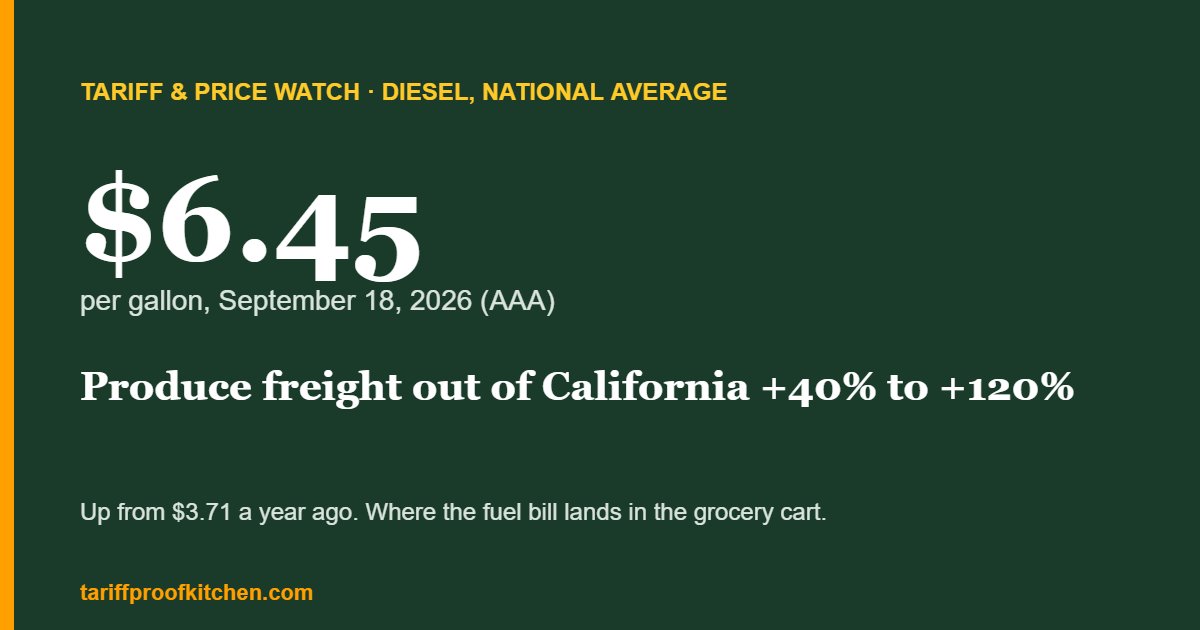
- Diesel averaged $6.45 a gallon nationally on September 18 and $6.49 on September 19, against $3.71 a year ago (AAA, read September 20).
- The EIA weekly on-highway diesel price came in at $6.285 for September 14, up 31.8 cents on the week and the highest in the series (EIA, September 15).
- Refrigerated freight out of California costs 40% to 120% more than a year ago, and rates for apples and pears out of Washington's Yakima Valley are at a four-year high (DAT Freight & Analytics, quoted by Reuters, September 18).
- Brent settled at $104.87 a barrel on September 18; crude has been above $100 since the summer as Strait of Hormuz traffic stays restricted (Reuters, September 18).
Key facts
- The AAA national average price of diesel was $6.448 per gallon on September 18, 2026 and $6.487 on September 19, 2026, compared with $3.706 a year earlier (AAA, gasprices.aaa.com, September 19, 2026).
- The U.S. Energy Information Administration's weekly on-highway diesel average was $6.285 per gallon for the week of September 14, 2026, up 31.8 cents from the prior week and $2.546 above a year earlier (EIA Gasoline and Diesel Fuel Update, September 15, 2026).
- Trucking rates for produce leaving California were 40% to 120% higher on September 18, 2026 than a year earlier, according to DAT Freight & Analytics principal analyst Dean Croke (Reuters, September 18, 2026).
- California's statewide diesel average reached $8.39 per gallon on September 18, 2026, up from $5.17 a year earlier (AAA, reported by the New York Post, September 18, 2026).
- The EIA's September 2026 outlook projects on-highway diesel averaging $5.55 per gallon in the fourth quarter of 2026 and $4.93 in the first quarter of 2027 (EIA Short-Term Energy Outlook, September 2026, as reported by the Daily Caller News Foundation, September 14, 2026).
This is a fast-moving story. Prices, tariffs and policy in this brief were correct as of September 20, 2026 and can change from one day to the next; we update when the primary sources do.
Diesel cost $6.45 a gallon on Friday, September 18, a record, against $3.71 a year earlier (AAA, September 18). That is the number behind every produce truck and every combine in the field this month. We priced a 3 lb bag of Gala apples at $4.49 this week; the trucks that bring them out of Washington now run on fuel that costs 74% more than last September.
What happened
The weekly numbers keep stepping up. EIA's on-highway average was $5.599 on August 31, $5.967 on September 7 and $6.285 on September 14 (EIA, September 15). AAA's daily series then ran $6.31 on September 16, $6.40 on September 17 and $6.45 on September 18 (AAA, reported by USA Today and Dallas Express). GasBuddy's Patrick De Haan counted 44 states at all-time diesel highs on September 17 (X post, quoted by AOL, September 18).
The farm side is where it bites first. Reuters visited a Missouri corn and cattle farm on September 18 where one combine burns 300 gallons of diesel; Purdue economist Michael Langemeier put fuel costs at $11 an acre above last year for corn and $7 for soybeans. A vegetable grower near Gonzales, California told Reuters his fuel bill went from about $5 to about $7 a gallon, a 40% rise.
Then the trucks. Croke told Reuters that refrigerated rates out of California are up 40% to 120% year on year and that independent truckers, who pay for fuel up front, may not survive further increases. Michigan State's David Ortega gave the plain version: most food moves on trucks, and those trucks use diesel (Reuters, September 18). Rail is not a full escape either. USDA data show the average fuel surcharge on grain rail shipments at 48 cents per car-mile in the second week of September, up 153% from a year earlier (Reuters, September 14).
Two signals ran the other way this weekend. The head of U.S. Central Command, Admiral Brad Cooper, said on September 19 that oil and LNG volumes through the Strait of Hormuz over the past two weeks were higher than at any point in the past six months (Bloomberg, September 19). And Iran's security chief Mohsen Rezaei said on September 19 that Tehran had sent mediators in Qatar and Pakistan its conditions for resuming talks, including an end to the naval blockade (Reuters, September 19). Brent slipped 0.93% on September 18 to $104.87 (Reuters).
What has not happened
No retail grocery index has moved yet on the September diesel spike; the next BLS CPI release, covering September, is due in mid-October. Ortega told Reuters that retailers may absorb short-term increases and that freight contracts signed at lower fuel prices do not yet carry the new surcharges. Bank of America analysts said on September 17 that seven straight weeks of rising diesel make it hard for surcharges to catch up (AOL, September 18). So the pass-through is coming, but it is not in shelf prices in a measurable way today.
No ceasefire exists. Iran's conditions are conditions, not an agreement, and Reuters reported Tehran is waiting on a reply from the White House. The Hormuz volume figures come from a military statement, and Iran maintains the strait is closed. Nothing in the last 48 hours changed the fuel supply picture for October.
There is no national diesel price cap or fuel tax holiday. The federal action so far is a 90-day waiver, effective September 16, letting fuel-tanker drivers work 16 hours in a 24-hour window instead of 14 (Reuters, September 17).
Which foods are exposed
Disclaimer: the freight rates, farm cost figures and per-food exposure below are calculations by third parties (DAT Freight & Analytics, university economists, growers quoted by Reuters), not official US government statistics. Only the EIA and AAA fuel prices are official series. Our cart estimate further down is our own planning number, not a forecast.
| Food | Why it is exposed | Domestic fallback |
|---|---|---|
| Fresh berries, lettuce, broccoli from California | Refrigerated truck rates out of California up 40-120% (Reuters, Sept 18) | Frozen vegetables packed regionally; apples and cabbage that ship denser |
| Apples and pears | Yakima Valley reefer rates at a four-year high mid-harvest (Reuters, Sept 18) | Local-orchard fruit at farm stands now; store apples cold, they keep 2-3 months |
| Fluid milk, yogurt | Daily refrigerated delivery, short shelf life, no inventory buffer (Ortega, Reuters, Sept 18) | Shelf-stable UHT milk, powdered milk for baking |
| Fresh meat and poultry | Refrigerated distribution plus feed grain shipped by rail with a 153% higher fuel surcharge (Reuters, Sept 14) | Freezer buys on markdown, whole birds instead of parts |
| Rice, dried beans, flour | Bulk, non-refrigerated, moves by rail; lowest fuel share per calorie | Already the fallback; buy the 20 lb bag |
What to do this month
Buy the refrigerated, long-haul items before the freight contracts reset. October is when carriers renegotiate fuel surcharges, and produce from California is the single most exposed line on the receipt. A 5 lb bag of carrots or a head of cabbage travels denser and cheaper than clamshell berries.
Shift one meal a week from fresh-trucked to frozen or dried. Frozen peas and corn were packed in July at July freight rates. A 1 lb bag ran us $1.19 at Aldi this week.
Fill the freezer on meat markdowns now rather than in November. Refrigerated trucking is the leg most exposed to the surcharge lag Ortega describes.
If you keep a stockpile list, put rice, beans, oats and canned tomatoes at the top; they are the categories with the smallest fuel share and the longest shelf life. Our stockpile guide has quantities for a family of four.
Editorial note: this brief was drafted with AI assistance from the sources below and checked by our editor before publication. Read How we work.
Sources
- AAA, read Sept 20, 2026 — National average fuel prices, regular and diesel
- EIA, week of Sept 14, 2026 — Gasoline and Diesel Fuel Update
- Reuters, Sept 18, 2026 — Record US diesel prices squeeze farmers; food prices may rise
- Reuters, Sept 14, 2026 — US rail fuel surcharges on grain hit record highs
- Reuters, Sept 18, 2026 — Oil settles lower, Brent $104.87
- Reuters, Sept 17, 2026 — US temporarily eases curb on working hours for fuel truck drivers
- Reuters, Sept 19, 2026 — Iran sends conditions for talks (Rezaei interview)
- Bloomberg, Sept 19, 2026 — Hormuz oil shipments hit six-month high, US commander says
- New York Post, Sept 18, 2026 — California diesel average $8.39
- FreightWaves via Yahoo Finance, Sept 15, 2026 — EIA weekly diesel at record $6.285
- Daily Caller News Foundation, Sept 14, 2026 — EIA September STEO diesel projections
- AOL, Sept 18, 2026 — AAA daily series and Bank of America note
- USA Today, Sept 17, 2026 — Diesel $6.39 on September 17
Frequently Asked Questions
See What This Does to Your Bill
Run the free Tariff Grocery Calculator: 12 questions, your Tariff Exposure Score and the swaps that cut it. Then the full 90-day system for $7.99.
Run the Calculator (free)