A new law allows 100% tariffs on Russian-oil buyers. No tariff exists yet. Shrimp, basmati and spices are the aisles to watch
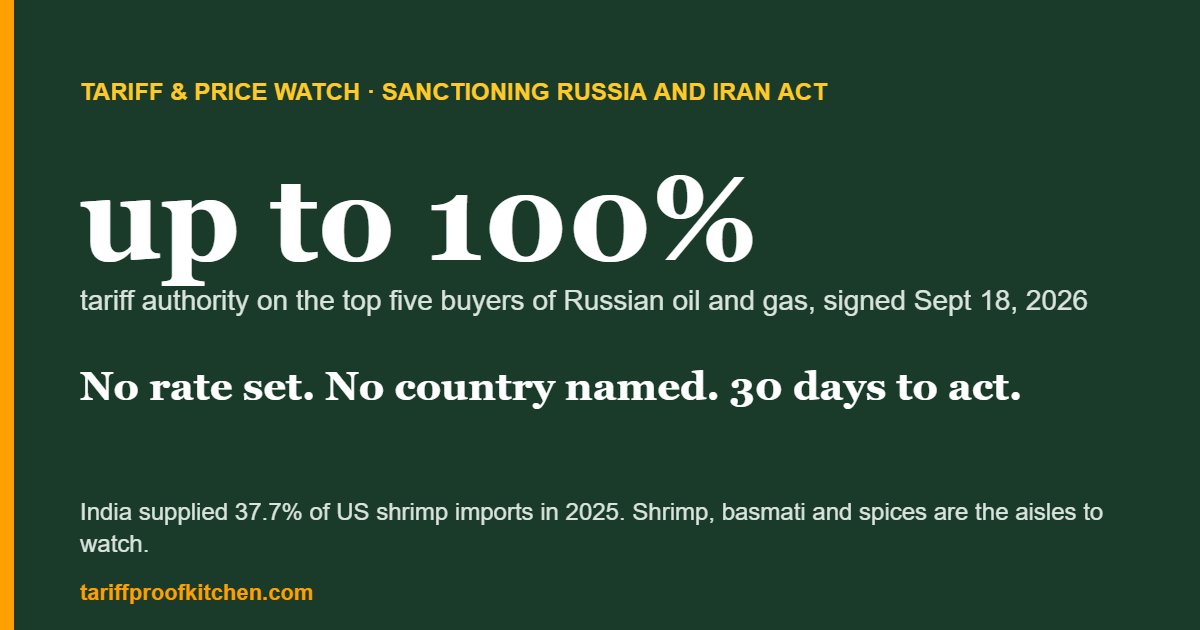
- H.R. 5334 was signed September 18 after passing the Senate in August and the House on September 16 (White House statement, September 18).
- The law lets the President set a tariff of up to 100% on imports from the five largest importers of Russian crude oil and natural gas over the prior 12 months, with the list reviewed every 180 days (Hindustan Times, September 20).
- Section 113 says the President "shall" raise the duty within 30 days "to a rate of up to 100 percent ad valorem"; the action is mandatory, the rate is not, no country is named, and a national-interest waiver exists (enrolled text of H.R. 5334, congress.gov).
- India shipped about 300,000 tons of shrimp to the US in 2025, 37.7% of all US shrimp imports (trade data compiled by Aqua Development, August 25, 2026; Tridge puts the figure at 297,571 tons, March 3, 2026).
Key facts
- The President signed H.R. 5334, the Lindsey O. Graham Sanctioning Russia and Iran Act of 2026, on September 18, 2026, according to a White House statement dated the same day.
- Section 113(a) of the Act states that "not later than 30 days after the date of the enactment of this Act, the President shall, notwithstanding any other provision of law, increase the rate of duty for all goods imported into the United States from a country described in subsection (c) ... to a rate of up to 100 percent ad valorem"; subsection (c) covers the five largest importers of Russian crude oil or natural gas over the preceding 12 months (enrolled text of H.R. 5334, congress.gov, accessed September 20, 2026).
- As of September 20, 2026, no tariff rate has been announced under the new law and no country has been designated (Hindustan Times, September 20, 2026).
- India exported roughly 300,000 tons of shrimp to the United States in 2025, about 37.7% of US shrimp imports of 795,641 tons (Aqua Development analysis of 2025 trade data, August 25, 2026).
- India exported 274,000 tonnes of basmati rice to the United States in fiscal year 2024-25, valued at $337 million (Mint, February 7, 2026).
This is a fast-moving story. Prices, tariffs and policy in this brief were correct as of September 20, 2026 and can change from one day to the next; we update when the primary sources do.
On September 18 the President signed H.R. 5334, the Lindsey O. Graham Sanctioning Russia and Iran Act of 2026. The White House statement says the law "authorizes and expands statutory sanctions, tariffs, and prohibitions on Russia and extends existing sanctions on Iran" (whitehouse.gov, September 18). The part that reaches a US grocery cart is a tariff authority of up to 100% on goods from the five largest buyers of Russian crude and gas. China and India are the two largest buyers by most counts, and between them they supply a good share of the shrimp, basmati rice, cumin and tea on American shelves. A 1 lb bag of frozen Indian shrimp was $7.99 at our Walmart this week.
What happened
The Senate passed the bill in August. The House followed on September 16 (Hindustan Times, September 20). The original draft, from Senators Graham and Blumenthal, carried a 500% ceiling on any buyer of Russian energy. The signed version narrows that to the five largest buyers and cuts the ceiling to 100% (Meduza, September 20). Goods imported directly from Russia can face up to 500%, but Russia is not a meaningful food supplier to the US, so that clause does not touch the cart.
The mechanics matter. The U.S. Trade Representative, with State and Energy, identifies the top five importers by volume over the prior 12 months. The statute then says the President "shall" raise duties on those countries within 30 days "to a rate of up to 100 percent" (Section 113(a), enrolled text). The Congressional Research Service summary adds that the duty applies to a top-five country "if such country knowingly makes new purchases of such products after enactment" (congress.gov bill summary). So the obligation to act is written as mandatory; the rate, which could be well under 100%, is not. Countries whose Russian gas purchases are under 15% of Russia's gas exports and are taking significant steps to cut them are exempt, a carve-out that helps several European buyers and does not help India or China (Hindustan Times, September 20). The President can waive the duty for any country by certifying a national-interest reason to Congress.
China's Commerce Ministry responded on September 20 that it opposes unilateral and secondary sanctions and reserves the right to take "all necessary measures" (Meduza, September 20). India's government has not, as of this writing, issued a formal response we could find.
For US shoppers the relevant lines are the ones where India or China is the anchor supplier. Frozen shrimp is the largest by value: India's frozen shrimp exports to the US were $2.33 billion in fiscal 2025-26, 93.55% of India's seafood sales to America (Economic Times, citing MPEDA, June 1, 2026). Basmati rice was $337 million in fiscal 2025 (Mint, February 7). Spices, tea, cashews and coffee from India entered at zero tariff under the February 2026 interim trade deal. China's food footprint in the US is smaller but concentrated: tilapia, processed seafood, garlic and apple juice concentrate. No source we found puts a current dollar figure on China's share of those lines, and we are not going to guess one.
What has not happened
No tariff has been imposed. The signature starts a 30-day clock; the rate, the country list and any waiver are still open.
No country has been named. Every report saying "China and India" is inferring from oil-import volumes, not from a USTR designation.
Existing tariffs on Indian food have not changed. Indian shrimp faced a total effective duty of 58.26% in the US from August 2025 until the February 2026 interim deal, which cut the rate on shrimp to 18% (S&P Global, February 2, 2026; Ocean Treasure, February 13, 2026). Separately, a 10% Section 301 duty tied to forced-labor enforcement applies to most Indian goods (Times of India, September 20). Those are the rates in force today.
Whether food is exempt is unsettled. Section 114(a) of the enrolled text says "sanctions and other measures under this title shall not apply to the conduct or facilitation of a transaction for the provision of agricultural commodities, food, medicine, medical devices, humanitarian assistance, or for humanitarian purposes" (congress.gov). The tariff clause sits in the same title, so a reading that shields food imports from Section 113 duties is possible, but we found no legal analysis or agency guidance saying so either way. Until USTR publishes implementing notices, treat shrimp and rice as exposed and watch for a carve-out.
Which foods are exposed
Disclaimer: the import volumes and shares in this section (Indian shrimp, basmati rice, tea, tilapia) are calculations by trade analysts, industry bodies and trade press working from customs data, not official US government statistics, and we have not yet matched them against NOAA or USITC tables. The legal facts above come from the enrolled text of the Act and the White House statement. Our cart estimate further down is our own planning number, not a forecast.
| Food | Why it is exposed | Domestic fallback |
|---|---|---|
| Frozen shrimp | India supplied about 37.7% of US shrimp imports in 2025 | Gulf wild-caught shrimp (pricier); Ecuador is now the top supplier and is not a Russian-oil buyer |
| Basmati rice | India shipped 274,000 t to the US in FY2025 ($337M) | US long-grain and Texas-grown basmati-style rice; jasmine from Thailand |
| Spices (cumin, turmeric, chili, black pepper) | India is a top-three source; entered at 0% since February | Store brands blend origins; buy whole seeds in bulk, they keep 2-3 years |
| Tea | India and China are the two largest US tea sources | Argentine black tea in many store brands; herbal teas from US growers |
| Tilapia, processed seafood | China is the largest supplier of frozen tilapia to the US | US catfish, Alaska pollock |
| Garlic, apple juice concentrate | China is widely described as a major source; no current figure in hand | Gilroy, California garlic; Washington apple juice, check the label |
What to do this month
Nothing dramatic. This is a watch item, not a buy signal, because the law sets no rate and names no country. What we would do is modest: if you cook with basmati weekly, buy the 10 lb bag now rather than the 2 lb, since the price is stable and the shelf life is a year or more. Same logic for whole cumin and coriander seed.
Shrimp is the one line where a tariff would show fast, because frozen inventory turns over in weeks. If a designation is announced, expect importers to shift toward Ecuador, which already took the top-supplier slot in October 2025 (Ocean Treasure, February 13). Prices would rise, but supply would not vanish.
Check the origin label on tea and apple juice. A store brand can switch origins without changing the box.
The tariff-proof grocery list already skews toward US-grown rice and domestic protein for reasons that predate this law.
Editorial note: this brief was drafted with AI assistance from the sources below and checked by our editor before publication. Read How we work.
Sources
- White House, Sept 18, 2026 — Congressional Bill H.R. 5334 Signed into Law
- Congress.gov, accessed Sept 20, 2026 — H.R. 5334 enrolled text (Sections 112, 113, 114)
- Congress.gov, CRS summary — H.R. 5334 summary
- Hindustan Times, Sept 20, 2026 — US law gives the President power to impose 100% tariffs on India, China over Russian oil
- Times of India, Sept 20, 2026 — Russia sanctions bill signed, may hit India's crude tap
- Meduza, Sept 20, 2026 — China Commerce Ministry response
- Meduza, Sept 20, 2026 — Sanctions law summary: 30 days to act, broad waiver authority
- Aqua Development, Aug 25, 2026 — India-US shrimp trade 2025: 300,051 t, 37.7%
- Tridge, Mar 3, 2026 — Indian shrimp exports to US 2025: 297,571 t
- Economic Times, Jun 1, 2026 — India seafood exports FY2025-26 (MPEDA)
- Mint, Feb 7, 2026 — Basmati exports to US FY25
- S&P Global, Feb 2, 2026 — Indian shrimp duty 58.26% before the interim deal
- Ocean Treasure, Feb 13, 2026 — US cuts tariff on Indian shrimp to 18%; Ecuador top supplier
- USDA ERS, updated Aug 4, 2026 — U.S. Food Imports data product
Frequently Asked Questions
See What This Does to Your Bill
Run the free Tariff Grocery Calculator: 12 questions, your Tariff Exposure Score and the swaps that cut it. Then the full 90-day system for $7.99.
Run the Calculator (free)