How much should groceries cost for a family of 4 in 2026? USDA's four food plans, from $236 to $387 a week
Last updated . We revise figures when USDA or BLS publish new data.
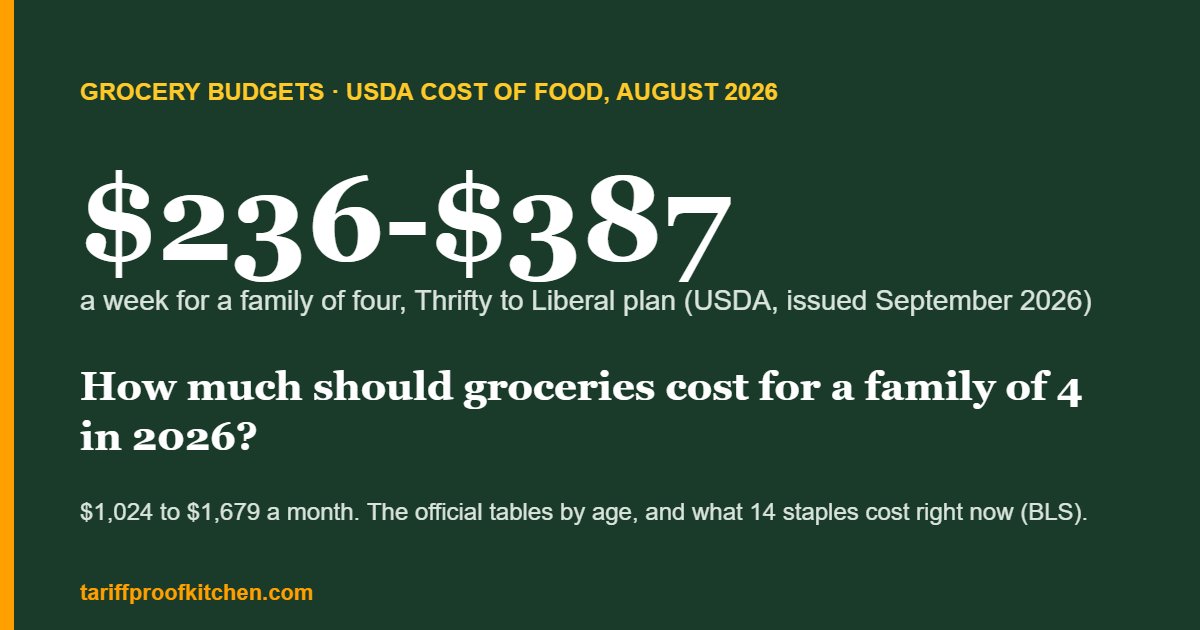
- USDA publishes four monthly grocery budgets. For August 2026 a family of four (two adults, children 6-8 and 9-11) comes to $236.30 a week on the Thrifty plan, $259.80 Low-cost, $320.50 Moderate-cost and $387.40 Liberal.
- Per month that is $1,023.70, $1,125.80, $1,388.20 and $1,678.70. The Thrifty figure is the one that sets the maximum SNAP benefit.
- Singles add 20 percent, couples add 10 percent to the per-person figures; households of five or six subtract 5 percent (USDA adjustment rules).
- USDA forecasts grocery prices up 2.4 percent for 2026 overall, with beef up 9.4 percent and eggs down 29.4 percent, so where you land inside the range depends on what is in the cart.
Key facts
- The USDA Thrifty Food Plan cost for the reference family of four (male and female aged 20-50, two children aged 6-8 and 9-11) was $236.30 per week and $1,023.70 per month in August 2026 (USDA Food and Nutrition Administration, Official USDA Thrifty Food Plan: U.S. Average, August 2026, issued September 2026).
- For the same four people, our arithmetic on USDA's per-person tables gives $259.80 per week ($1,125.80 per month) on the Low-cost plan, $320.50 per week ($1,388.20 per month) on the Moderate-cost plan and $387.40 per week ($1,678.70 per month) on the Liberal plan (USDA, Cost of Food at Home at Three Levels, August 2026; adult rows are 19-50 years in these three plans).
- USDA's adjustment rule for household size: one person add 20 percent, two people add 10 percent, three add 5 percent, four no adjustment, five or six subtract 5 percent, seven or more subtract 10 percent (USDA, footnote 2 of both reports).
- The U.S. city average price of 100% ground beef was $6.923 per pound in August 2026 (up 9.6 percent in a year) and a dozen grade A large eggs was $2.272 (down 36.7 percent) (Bureau of Labor Statistics, average price data, August 2026).
- USDA's Economic Research Service forecasts food-at-home prices up 2.4 percent in 2026, in a range of 1.8 to 3.0 percent (Food Price Outlook, September 25, 2026).
The honest answer to "how much should groceries cost" is that the government already publishes one, every month, and almost nobody reads it. USDA's Center for Nutrition Policy and Promotion prices four market baskets, from a bare-bones Thrifty plan to a Liberal one, for every age and sex, and adds them up for a reference family of four. The August 2026 tables came out in September. Here they are, with the per-person rows so you can build your own household, and a second table of what 14 staples actually cost at the register in August, from the Bureau of Labor Statistics.
The four USDA budgets for a family of four
| USDA food plan (August 2026) | Per week | Per month |
|---|---|---|
| Thrifty (the SNAP benchmark) | $236.30 | $1,023.70 |
| Low-cost | $259.80 | $1,125.80 |
| Moderate-cost | $320.50 | $1,388.20 |
| Liberal | $387.40 | $1,678.70 |
The reference family is two adults and two children aged 6-8 and 9-11. The Thrifty row is USDA's own total. The other three rows are our arithmetic from USDA's per-person tables, because USDA prints a family total only for the Thrifty plan. One quirk to know: the Thrifty plan uses adult age bands of 20-50, the other three plans use 19-50, so the sums are not perfectly aligned; the difference is cents, not dollars.
All four plans assume every meal and snack is made at home. Restaurant meals, delivery and the coffee on the way to work are on top of these numbers, not inside them.
Per-person weekly costs, by age (August 2026)
| Person | Thrifty | Low-cost | Moderate | Liberal |
|---|---|---|---|---|
| Child, 1 year | $26.40 | $38.10 | $42.90 | $52.20 |
| Child, 2-3 years | $39.80 | $40.10 | $47.80 | $58.20 |
| Child, 4-5 years | $43.50 | $41.30 | $51.10 | $61.80 |
| Child, 6-8 years | $48.30 | $60.50 | $70.30 | $82.20 |
| Child, 9-11 years | $55.80 | $62.50 | $80.70 | $94.00 |
| Female, 12-13 | $51.70 | $62.20 | $74.20 | $92.50 |
| Female, 14-19 (14-18 in the three upper plans) | $60.00 | $62.40 | $74.60 | $92.20 |
| Female, 20-50 (19-50) | $58.50 | $63.60 | $77.60 | $99.00 |
| Female, 51-70 | $54.50 | $62.00 | $76.40 | $92.10 |
| Female, 71+ | $60.10 | $61.90 | $76.10 | $91.00 |
| Male, 12-13 | $59.70 | $73.10 | $90.60 | $106.30 |
| Male, 14-19 (14-18) | $75.30 | $74.40 | $93.10 | $109.30 |
| Male, 20-50 (19-50) | $73.60 | $73.20 | $91.90 | $112.20 |
| Male, 51-70 | $64.90 | $69.00 | $86.50 | $103.60 |
| Male, 71+ | $61.90 | $68.30 | $83.90 | $103.30 |
Source: USDA Food and Nutrition Administration, Official USDA Food Plans, U.S. Average, August 2026 (Thrifty; Low-cost, Moderate-cost and Liberal), issued September 2026. Weekly figures; USDA computes monthly as weekly × 4.333. Costs are for people in four-person households; apply the household-size adjustment below for other sizes.
Build your own number
Add the weekly figure for each person in your home, then apply USDA's adjustment: one person add 20 percent, two people add 10 percent, three add 5 percent, four none, five or six subtract 5 percent, seven or more subtract 10 percent. A few worked examples, all our arithmetic on the August tables:
- One adult, 20-50, living alone: Thrifty $88.30 a week for a man ($73.60 × 1.2) or $70.20 for a woman; Moderate $110.30 or $93.10.
- A couple, 20-50: Thrifty $145.30 a week (about $630 a month); Moderate $186.50 a week (about $808 a month).
- Two adults and a toddler (2-3): Thrifty ($73.60 + $58.50 + $39.80) × 1.05 = $180.50 a week; Moderate ($91.90 + $77.60 + $47.80) × 1.05 = $228.20.
- Two adults and three children (6, 10, 15-year-old boy): Thrifty ($73.60 + $58.50 + $48.30 + $55.80 + $75.30) × 0.95 = $295.90 a week; Moderate ($91.90 + $77.60 + $70.30 + $80.70 + $93.10) × 0.95 = $392.90.
If you spend more than the Liberal figure for your household, you are paying for convenience, restaurant-quality ingredients or waste. If you spend less than Thrifty, you are either very good at this or skipping food groups. Our calculator takes the next step and tells you how much of your basket sits in tariff-exposed items.
What 14 staples cost right now (BLS, August 2026)
The USDA plans are market baskets updated with price indexes. For actual shelf prices, the Bureau of Labor Statistics publishes monthly U.S. city averages for about 150 items. The ones that matter most for a family budget:
| Item (BLS U.S. city average) | Aug 2026 | Aug 2025 | Change |
|---|---|---|---|
| Ground beef, 100% beef, per lb | $6.92 | $6.32 | +9.6% |
| Chicken breast, boneless, per lb | $4.17 | $4.21 | -0.9% |
| Chicken, whole, per lb | $2.01 | $2.08 | -3.1% |
| Bacon, sliced, per lb | $6.61 | $7.21 | -8.4% |
| Eggs, grade A large, per dozen | $2.27 | $3.59 | -36.7% |
| Milk, whole, per gallon | $4.23 | $4.17 | +1.4% |
| Cheddar cheese, per lb | $5.98 | $6.12 | -2.3% |
| Bread, white, per lb | $1.82 | $1.84 | -1.0% |
| Rice, white long grain, per lb | $1.11 | $1.06 | +4.9% |
| Coffee, ground roast, per lb | $9.30 | $8.87 | +4.8% |
| Sugar, white, per lb | $1.02 | $1.04 | -1.5% |
| Bananas, per lb | $0.65 | $0.67 | -2.1% |
| Oranges, navel, per lb | $1.71 | $1.80 | -4.8% |
| Potatoes, white, per lb | $0.98 | $1.00 | -2.5% |
Source: Bureau of Labor Statistics, Average Price Data (series APU0000703112, FF1101, 706111, 704111, 708111, 709112, 710212, 702111, 701312, 717311, 715211, 711211, 711311, 712112), August 2026 and August 2025; percentage changes are our arithmetic. Eggs are the swing item: a dozen cost $3.59 a year ago and $2.27 now. Ground beef went the other way, up 60 cents a pound. That is why two households with the same USDA plan can be $30 a week apart.
Where the money goes in 2026
USDA's September outlook has groceries up 2.4 percent for the year, a touch under the 20-year average, with the spread inside it wider than usual: beef and veal +9.4 percent, fresh vegetables +5.7 percent, sugar and sweets +6.6 percent, eggs -29.4 percent, dairy +0.1 percent (USDA ERS, September 25, 2026). Tariffs land on top of that for imported lines, which is the subject of this site. The practical reading: a family that eats a lot of ground beef, coffee and imported cheese is running above the USDA plan for its size in 2026; a family that leans on eggs, chicken, rice, beans and store-brand bread is running below it.
Three things keep a household at or under its plan in this market. Buy protein by the month, not the week: ground beef on the weekly markdown into the freezer, eggs at $2.27 as the default dinner protein twice a week. Buy the long-haul produce frozen and the short-haul produce fresh; the Price Watch has the current truck rates. And move ten name-brand items to store brands, which is worth $30-40 a month at the Moderate plan and has no tariff exposure at all. The tariff-proof grocery list is built on exactly that.
Frequently Asked Questions
Stop Overpaying at the Grocery Store
The Tariff-Proof Kitchen gives you 90 days of meal plans, 40+ budget recipes, and a complete shopping system designed for 2026 prices. Save $200+/month starting this week.
Get the Full Guide — $7.99