The US import ban on Canadian whey, beer, whisky and molasses starts Tuesday. What changes at the store, and what does not
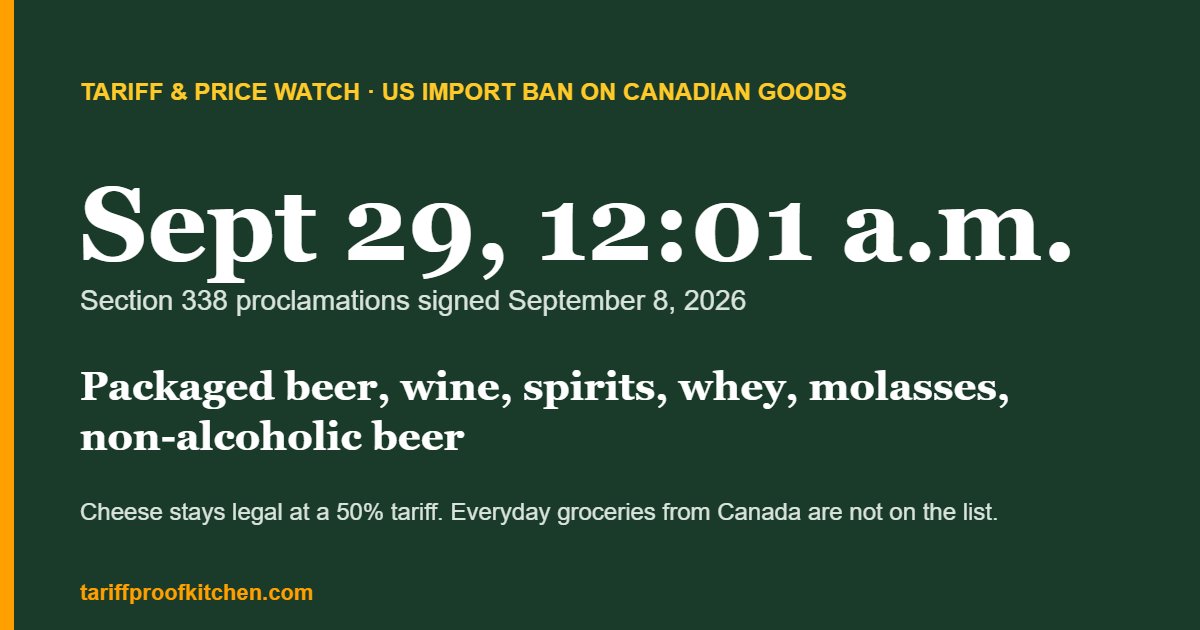
- The ban on listed Canadian dairy-related and alcohol products applies to goods imported on or after 12:01 a.m. Eastern time on September 29, 2026 (White House proclamation, September 8, 2026).
- The dairy annex covers eight whey lines, five molasses lines and non-alcoholic beer; the alcohol annex covers packaged malt beer, grape wine in containers up to 4 liters, cider, vermouth, and whisky, gin, vodka, rum and liqueurs in containers of 4 liters or less (White House Annex I documents, September 8, 2026).
- Twenty-three cheese lines were added to the 50% Section 338 tariff on September 15, 2026, and stay legal to import (Alcohol Scope Modification Annex I, September 8, 2026).
- No new White House action on Canada was published between September 20 and September 28, 2026 (whitehouse.gov Presidential Actions and Fact Sheets indexes, read September 28, 2026).
Key facts
- Products of Canada listed in the dairy annex, including whey protein concentrates, dried whey, cane molasses and non-alcoholic beer, are excluded from importation into the United States effective for goods imported on or after 12:01 a.m. Eastern time on September 29, 2026 (White House proclamation, September 8, 2026).
- Banned goods that were imported but not entered for consumption before September 29, 2026 remain subject to the 50 percent duty set by Proclamation 11047 (White House proclamation, September 8, 2026).
- The alcohol annex bans Canadian beer made from malt (HTSUS 2203.00.00), grape wine in containers holding 4 liters or less, cider, vermouth, and whiskies, gin, vodka, rum and liqueurs in containers holding 4 liters or less (White House Annex I Alcohol, September 8, 2026).
- On September 15, 2026 the United States added 23 cheese tariff lines, including cheddar, Edam, Gouda, Swiss and processed cheese, to the 50 percent Section 338 tariff on products of Canada; cheese is not on either ban list (White House Alcohol Scope Modification Annex I and fact sheet, September 8, 2026).
- Canada's counter-tariffs of 15, 25 and 50 per cent on $27.6 billion of imports from the United States took effect September 8, 2026, with dairy products such as cheese at 25 per cent (Finance Canada, August 25, 2026).
This is a fast-moving story. Prices, tariffs and policy in this brief were correct as of September 28, 2026 and can change from one day to the next; we update when the primary sources do.
At 12:01 a.m. Eastern on Tuesday, September 29, 2026, a list of Canadian products stops entering the United States. The list comes from two proclamations signed on September 8 under Section 338 of the Tariff Act of 1930 (White House, September 8, 2026). We re-read the proclamation, the annexes and the White House action index on Sunday night, September 28. Nothing has been added, removed or postponed since September 8. For a grocery shopper the items are packaged Canadian beer, wine, cider and spirits, eight forms of whey, five forms of molasses, and non-alcoholic beer. The 2 lb tub of whey protein with "Product of Canada" on the back is the line to check.
What happened
The timeline is short. The 50% tariffs on three groups of Canadian goods took effect on August 22, 2026 after, in the proclamation's words, Canada "reneged on its commitment, ceased negotiating in good faith" (White House, September 8). On August 25, Finance Canada answered with counter-tariffs on $27.6 billion of US goods, effective September 8 (Finance Canada, August 25). On September 8 the White House moved part of the tariffed list to an outright ban, with a three-week delay to September 29, and added cheese to the 50% list from September 15 (White House fact sheet, September 8).
The three weeks are up Tuesday. The proclamation is written around the moment of import: goods that cross on or after 12:01 a.m. Eastern do not enter; goods already imported but not yet cleared before that time pay the 50% duty (White House proclamation, September 8). In practice a distributor with Canadian rye sitting in a bonded warehouse can still clear it at 50%. A truck arriving at the Detroit crossing on Tuesday morning cannot.
Container size decides the alcohol list. Whisky, rum, vodka, gin and liqueurs are banned in containers of 4 liters or less, which is every retail bottle. Whiskies and liqueurs shipped in containers over 4 liters came off the 50% tariff on September 15 (Annex I, Part B). Bulk Canadian whisky bottled in the United States keeps flowing; a bottle filled and labeled in Canada stops at the border.
We checked the White House action index on the night of September 28. The last Canada-related entry is still September 8. No exemption, delay or deal appears on any primary page we read.
What has not happened
Cheese is not banned. Twenty-three cheese lines pay a 50% tariff since September 15 and stay legal to import (Annex I, Part A). A Canadian cheddar can still be on the shelf in October; it costs the importer half again its value at the border.
Pork, beef, wheat, canola oil, maple syrup and fresh produce from Canada are on neither annex we read. The everyday basket is not on Tuesday's list.
No primary page we read puts a dollar figure on US imports of Canadian whey, cheese or beer, and no US retailer has published a shelf-price change tied to this ban. We are not going to estimate either.
No talks are recorded on the primary pages. Canadian outlets reported on September 27 that both trade ministries describe contact as ongoing; we could not read the underlying interview, so we leave it there.
Which foods are exposed
| Food | Why it is exposed | Domestic fallback |
|---|---|---|
| Whey protein powder and bars made with Canadian whey | Eight whey lines banned from September 29 (Annex I Dairy) | Tubs that list US-sourced whey; check the country-of-origin line |
| Molasses (baking, barbecue sauce, brown-sugar substitute) | Five molasses lines banned from September 29 (Annex I Dairy) | US-refined molasses from Louisiana and Florida cane |
| Canadian cheddar, Gouda, Swiss-style, blue and processed cheese | 50% Section 338 tariff since September 15, still importable | Wisconsin, Vermont and Oregon block cheese, store brands |
| Canadian packaged beer, cider, ice wine, non-alcoholic beer | Banned in retail packaging from September 29 (Annex I Alcohol and Dairy) | Domestic beer; New York, Michigan and Oregon cider |
| Canadian whisky in retail bottles | Banned in containers of 4 liters or less from September 29 | Brands bottled in the US from bulk whisky; American rye |
What to do this month
Read the whey label before you buy. If it says product of Canada, the retailer cannot restock it after Tuesday. If you use a scoop a day, one extra 2 lb tub covers a month while you switch brands. Powders made from US milk are unaffected.
Molasses keeps for years unopened. A 12 oz jar for fall baking is enough, and US-refined molasses stays on the shelf at the same price.
If Canadian cheese is a staple, buy from what is on the shelf now and freeze it. Hard cheese freezes well for cooking; a 2 lb block wrapped tight keeps three months. The 50% tariff has been in the wholesale price since September 15, so the discount, if any, is old stock.
For Canadian beer, cider and whisky, expect brands to thin out through October as distributors run down inventory. Domestic substitutes cost the same or less, so there is no reason to stockpile.
Put the money toward the lines that are moving for other reasons: beef and coffee, per the USDA outlook of September 25. Our tariff-proof grocery list has this month's swaps.
The monthly numbers behind this brief, USDA forecast, BLS shelf prices and diesel, are on the food prices 2026 tracker.
Editorial note: this brief was drafted with AI assistance from the sources below and checked by our editor before publication. Read How we work.
Sources
- White House, Sept 8, 2026 (read Sept 28) — Proclamation excluding certain Canadian products (dairy)
- White House, Sept 8, 2026 — Annex I Dairy: banned products
- White House, Sept 8, 2026 — Annex I Alcohol: banned products
- White House, Sept 8, 2026 — Alcohol Scope Modification Annex I (cheese added, bulk whisky removed)
- White House, Sept 8, 2026 — Fact sheet: response to Canada's retaliation
- White House, read Sept 28, 2026 — Presidential Actions index (no Canada action after September 8)
- Finance Canada, Aug 25, 2026 — Canada announces targeted countermeasures
- Global News, Sept 27, 2026 (secondary, no figure used) — New U.S. bans to take effect Tuesday
Frequently Asked Questions
See What This Does to Your Bill
Run the free Tariff Grocery Calculator: 12 questions, your Tariff Exposure Score and the swaps that cut it. Then the full 90-day system for $7.99.
Run the Calculator (free)