USDA now sees grocery prices up 2.4% in 2026 with beef up 9.4% and eggs down 29%. Diesel eased to $6.47, its first week off the record
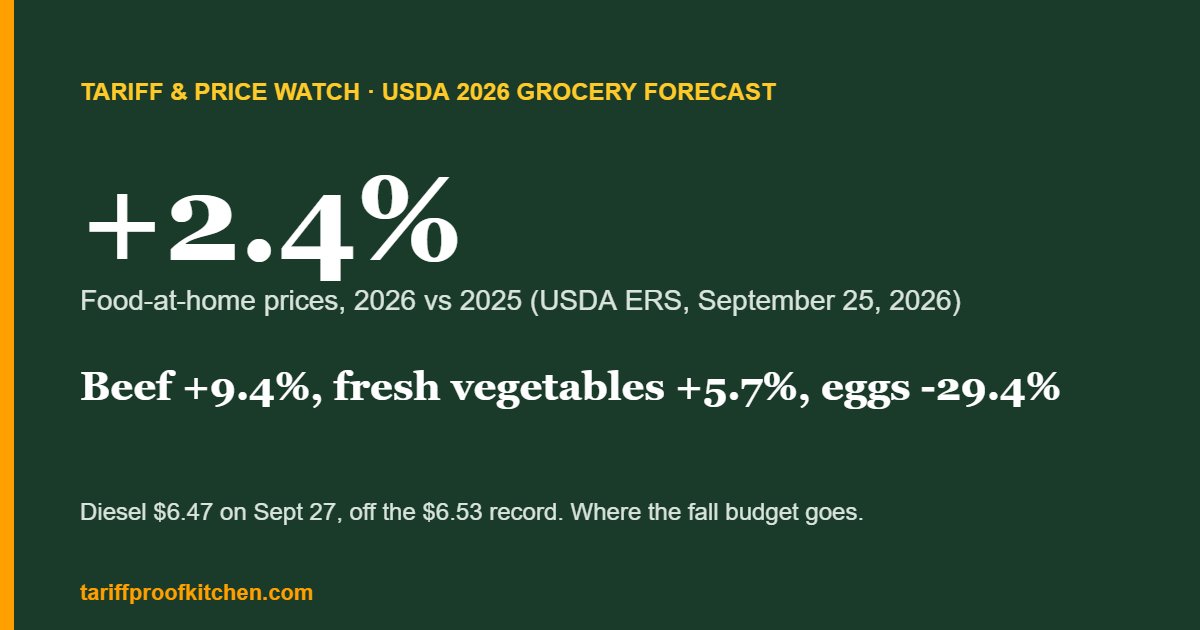
- USDA ERS forecasts food-at-home prices up 2.4% in 2026 (interval 1.8% to 3.0%) and all food up 2.9%; the food-at-home CPI was unchanged from July to August 2026 and 2.2% above August 2025 (USDA ERS, September 25, 2026).
- Beef and veal are forecast up 9.4% in 2026 (7.4% to 11.6%); federally inspected beef production is running about 2% below a year ago (USDA ERS, September 25, 2026).
- Eggs are forecast down 29.4% in 2026; August egg prices were 23.0% below August 2025 (USDA ERS, September 25, 2026).
- Diesel averaged $6.471 on September 27, 2026 against a record $6.528 on September 22; the EIA weekly average for September 21 was $6.529, up 74.2% on a year earlier (AAA, September 27, 2026; EIA, September 22, 2026).
Key facts
- USDA's Economic Research Service forecasts that food-at-home prices will increase 2.4 percent in 2026, with a forecast interval of 1.8 to 3.0 percent, and that all food prices will increase 2.9 percent (USDA ERS Food Price Outlook, September 25, 2026).
- Beef and veal prices are forecast to increase 9.4 percent in 2026, with a forecast interval of 7.4 to 11.6 percent; beef prices in August 2026 were 5.9 percent higher than in August 2025 (USDA ERS Food Price Outlook, September 25, 2026).
- Egg prices are forecast to decrease 29.4 percent in 2026, with a forecast interval of -32.9 to -25.2 percent, after rising 21.9 percent in 2025 (USDA ERS Food Price Outlook, September 25, 2026).
- The US average retail price of on-highway diesel was $6.529 per gallon in the week of September 21, 2026, up $2.780 or 74.2 percent from a year earlier (EIA Gasoline and Diesel Fuel Update, September 22, 2026).
- AAA's national average for diesel was $6.471 per gallon on September 27, 2026, below the record of $6.528 set on September 22, 2026; regular gasoline was $4.480 (AAA, September 27, 2026).
This is a fast-moving story. Prices, tariffs and policy in this brief were correct as of September 28, 2026 and can change from one day to the next; we update when the primary sources do.
On Friday, September 25, USDA's Economic Research Service published its September Food Price Outlook. Grocery prices are forecast to rise 2.4% in 2026 over 2025, a little under their 20-year average of 2.6% (USDA ERS, September 25, 2026). The average hides the spread. Beef is forecast up 9.4%, fresh vegetables up 5.7%, sugar and sweets up 6.6%, and eggs down 29.4%. Two days later, AAA's national diesel average read $6.47 a gallon, the first full week below the $6.53 record set on September 22 (AAA, September 27, 2026). A dozen large eggs is the line on the receipt that has moved most, and for once in the right direction.
What happened
The USDA outlook is a statistical forecast built on the August CPI and PPI, so it says as much about the last twelve months as the next three. Food at home was flat from July to August and up 2.2% on the year (USDA ERS, September 25). Seven of the 15 grocery categories fell in August, one was unchanged, seven rose. The two big movers were eggs, up 3.5% in the month, and fats and oils, up 1.4%.
Beef is the number that matters for a family of four. Retail beef slipped 0.6% from July to August but was still 5.9% above a year earlier, and ERS keeps its 2026 forecast at 9.4% because "federally inspected beef production was about 2 percent lower year over year" and is expected to stay below year-ago levels through the end of 2026 (USDA ERS, September 25). Farm-level cattle prices fell 6.4% from July to August and wholesale beef fell 3.0%, and cattle were 3.9% below a year earlier after running above year-ago levels every month from January to July (USDA ERS, September 25); ERS still forecasts wholesale beef up 8.5% for the year.
Eggs are the good news. August egg prices were 23.0% below August 2025, and ERS forecasts a 29.4% drop for the year as production recovers and fewer flocks are lost to avian flu (USDA ERS, September 25). Dairy is forecast up 0.1%, with ERS noting that higher milk output "is expected to put downward pressure on prices for some key dairy products, including cheese". Coffee is the exception in beverages: retail coffee was 6.1% higher in August than a year earlier, and nonalcoholic beverages as a group are forecast up 4.2%.
On fuel, the record run paused. AAA's diesel average peaked at $6.528 on September 22 and read $6.471 on September 27, with a week-ago figure of $6.505 (AAA, September 27). EIA's weekly survey, taken a day before the peak, had diesel at $6.529, up 24.4 cents in a week and $2.78 in a year (EIA, September 22). Regular gasoline sat at $4.48 by both measures, up 41.1% on the year in the EIA survey.
What has not happened
Diesel has not come down in any way a grocer would notice. $6.47 is 6 cents below the record and $2.78 above last September. Freight contracts written this month were priced at the peak.
We do not know why diesel eased. Several outlets report progress in US-Iran talks on the Strait of Hormuz; we could not read those reports on a primary page, so this brief does not repeat them.
USDA's forecast does not model tariffs or fuel. The summary findings page contains no mention of either. It is a trend model fitted to recent price data, and its 2027 interval for groceries runs from -5.0% to +9.2%, which is USDA's own way of saying it does not know.
The August CPI does not yet show the September diesel spike. August energy was up 16.3% on the year and gasoline up 27.4% (BLS, September 11), with food at home up 2.2%. The September CPI comes out in mid-October.
Which foods are exposed
| Food | Why it is exposed | Domestic fallback |
|---|---|---|
| Beef (ground, roasts, steaks) | Forecast +9.4% in 2026; production about 2% below a year ago (USDA ERS, September 25) | Pork (+1.2% forecast), chicken (+1.0%), dried beans; buy chuck on promotion and freeze |
| Fresh vegetables | Forecast +5.7%; long-haul trucking priced at record diesel | Frozen vegetables, cabbage, carrots, onions, in-season local |
| Sugar and sweets, chocolate candy | Forecast +6.6%; candy is the driver (USDA ERS) | Store-brand baking chocolate, homemade treats |
| Coffee | Retail coffee +6.1% y/y in August (USDA ERS) | Store-brand ground coffee, larger cans on sale |
| Eggs | Forecast -29.4% in 2026 | No fallback needed; eggs are the cheapest protein again |
| Dairy, cheese | Forecast +0.1%; milk output rising | Domestic block cheese, store brands |
What to do this month
Move protein spending from beef to eggs. At a 29% drop for the year, a dozen large eggs is back to being the cheapest protein in the store. Two egg dinners a week in place of ground beef is the single largest swap in this forecast.
Buy beef on the dips, not on the schedule. Wholesale beef fell 3% in August and cattle fell 6%; that shows up as short retail promotions, usually on chuck and round. When it does, buy a month's worth and freeze it in 1 lb packs.
Shift the vegetable list toward what travels short or frozen. Fresh vegetables carry the diesel bill twice, from field to packer and packer to store. A 16 oz bag of frozen peas or corn was packed before the fuel spike and keeps.
Lock in coffee when it is on promotion. Coffee is up 6.1% on the year with no relief in the forecast; a 30 oz can on sale is worth the cupboard space.
Run your own list through our calculator with beef at +9% and eggs at -29% to see where your household lands.
The monthly numbers behind this brief, USDA forecast, BLS shelf prices and diesel, are on the food prices 2026 tracker.
Editorial note: this brief was drafted with AI assistance from the sources below and checked by our editor before publication. Read How we work.
Sources
- USDA ERS, Sept 25, 2026 — Food Price Outlook, Summary Findings
- BLS, Sept 11, 2026 — Consumer Price Index, August 2026
- AAA, data as of Sept 27, 2026 — National average fuel prices
- EIA, Sept 22, 2026 — Gasoline and Diesel Fuel Update, week of September 21
- CNBC, Sept 25, 2026 (not read; no figure used) — US crude falls nearly 8% for the week after talks at the UN
Frequently Asked Questions
See What This Does to Your Bill
Run the free Tariff Grocery Calculator: 12 questions, your Tariff Exposure Score and the swaps that cut it. Then the full 90-day system for $7.99.
Run the Calculator (free)