How Tariffs Affect Sugar and Sweets Prices in 2026 (+6.7%)
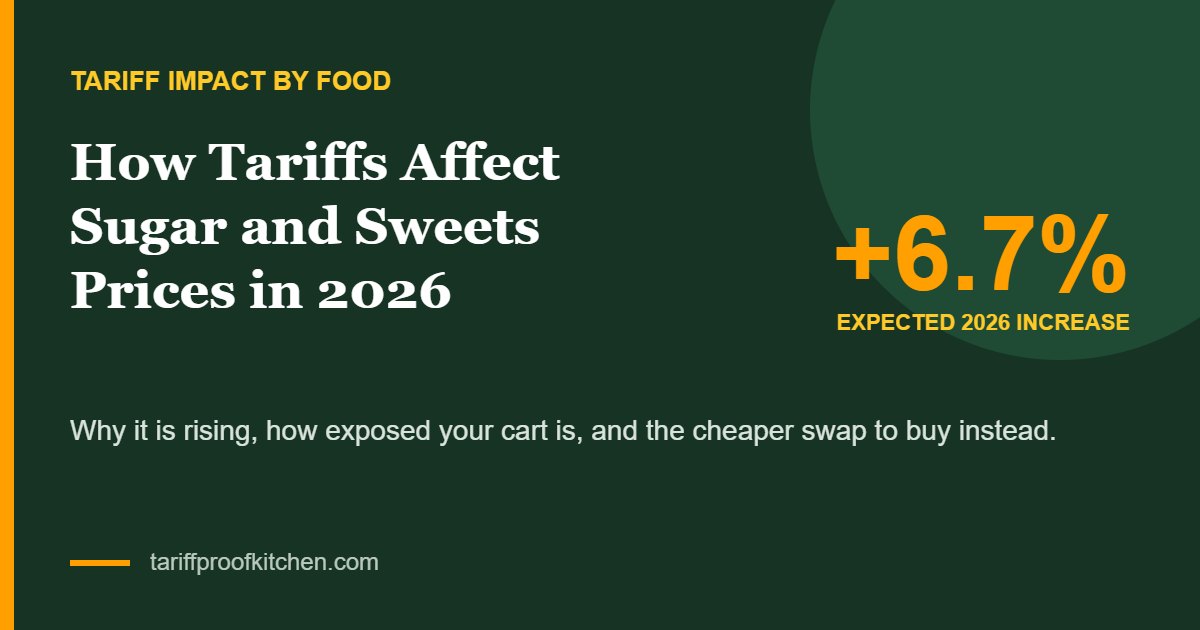
- Expected 2026 price change: +6.7%
- Tariff exposure: Moderate — main origin: US, Mexico, Brazil (sugar); West Africa (cocoa)
- Typical family-of-4 spend: about $25 per month
- Best swap: Store-brand sugar bought in bulk, home baking instead of packaged sweets, fruit for snacks
The USDA projects sugar and sweets as the fastest-rising staple category in 2026, driven by import quotas, tariffs on Mexican sugar and cocoa costs.
What it costs you
| Metric | Sugar and Sweets |
|---|---|
| Expected 2026 increase | +6.7% |
| Tariff exposure level | Moderate |
| Main origin | US, Mexico, Brazil (sugar); West Africa (cocoa) |
| Typical monthly spend (family of 4) | $25 |
| Shelf life / stockpile window | Sugar: indefinite |
At a typical spend of $25 a month, a +6.7% increase adds only a few dollars on its own. The problem is that sugar and sweets rarely travels alone: households that buy it weekly usually buy several other exposed categories too, and the total quietly reaches $30-80 a month. Run the Tariff Grocery Calculator to see your combined number.
The swap that works
Store-brand sugar bought in bulk, home baking instead of packaged sweets, fruit for snacks. The goal is not to give up sugar and sweets entirely, but to move the everyday purchase to a lower-exposure version and keep the imported one for when it is on promotion.
Other foods to check
Frequently Asked Questions
Stop Overpaying at the Grocery Store
The Tariff-Proof Kitchen gives you 90 days of meal plans, 40+ budget recipes, and a complete shopping system designed for 2026 prices. Save $200+/month starting this week.
Get the Full Guide — $7.99