Diesel $6.28 on October 13: the tax order's 5-day deadline passed with no guidance
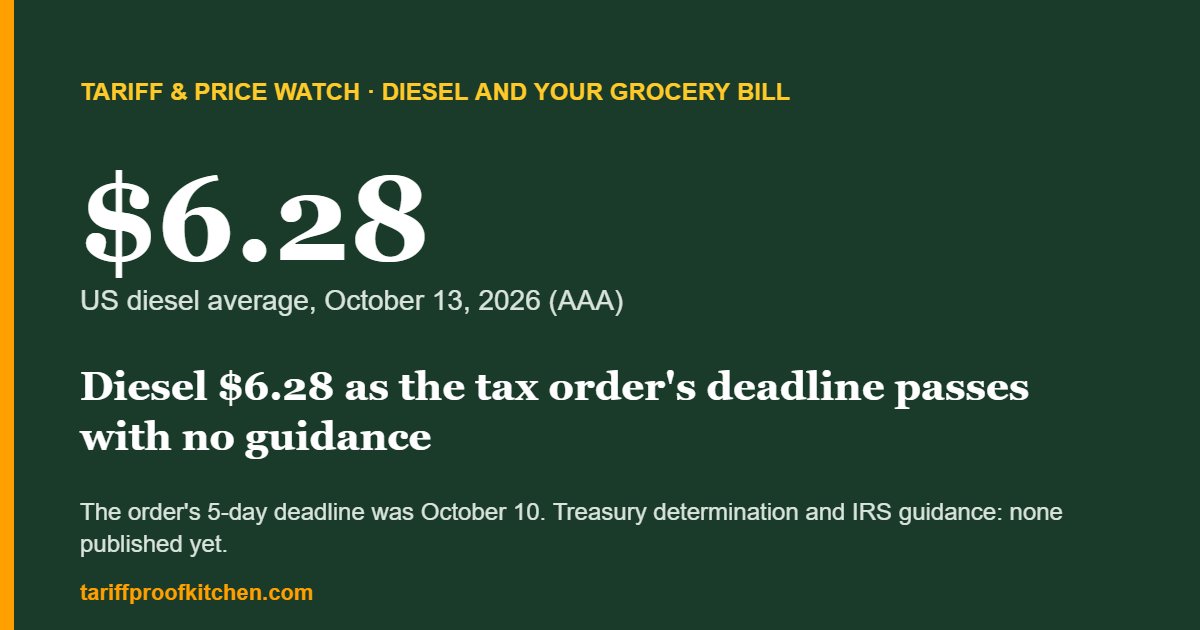
- US diesel averaged $6.2787 a gallon on October 13, 2026, per AAA: 24.9 cents below the September 22 record of $6.5276, 3.6 cents below a week earlier, and $2.63 (72%) above a year ago.
- Executive Order 14435 of October 5 gave the Treasury Secretary 5 days to decide on a diesel-tax deferral and to have the IRS announce dyed-diesel penalty relief. That was October 10. As of October 14 we find no determination, no IRS announcement and no Federal Register notice.
- EIA's October 7 release put US distillate stocks at 105.1 million barrels in the week ending October 2, 13.5% below a year earlier, with exports at 1.764 million barrels a day, the highest of the past five weekly readings.
Key facts
- The US average diesel price was $6.2787 per gallon on October 13, 2026, against a record $6.5276 on September 22, 2026 and $3.6533 a year earlier (AAA, gasprices.aaa.com, read October 14, 2026).
- Section 2(a) of Executive Order 14435 (signed October 5, 2026, published October 9 at 91 FR 64747) requires the Treasury Secretary, "within 5 days of the date of this order", to determine whether relief is authorized under 26 U.S.C. 7508A; section 2(c) requires the IRS to announce within the same 5 days that it will not impose dyed-diesel penalties under 26 U.S.C. 6715 for October 5 to December 31, 2026 (whitehouse.gov; Federal Register doc. 2026-20855).
- EIA retail diesel was $6.199 on October 5, 2026, down 18.3 cents on the week and $2.488 above a year earlier; the Midwest was $6.286 and California $8.082 (EIA Gasoline and Diesel Fuel Update, released October 6, 2026).
- US distillate fuel stocks were 105,138 thousand barrels in the week ending October 2, 2026, against 121,559 thousand in the week ending October 3, 2025 (EIA Weekly Petroleum Status Report series, released October 7, 2026).
This is a fast-moving story. Prices, tariffs and policy in this brief were correct as of October 14, 2026 and can change from one day to the next; we update when the primary sources do.
What happened
Diesel has stopped falling, for now. AAA's national average was $6.2787 on October 13, up 1.2 cents from the day before, after three weeks of declines from the September 22 record. The pump price is still $2.63 above October 2025. A 100-gallon tractor-trailer fill costs about $263 more than it did a year ago at that average, before any surcharge a carrier adds on top.
The policy document that has not arrived is Treasury's. Executive Order 14435, signed October 5, told the Treasury Secretary to decide within five days whether a "qualifying event" under 26 U.S.C. 7508A lets him defer the 24.4-cent federal diesel excise tax for October 5 through December 31, and told the IRS to announce in the same window that it would not penalize highway use of dyed (untaxed) diesel. Five days from October 5 is October 10. At 05:45 UTC on October 14 the IRS newsroom's newest release is dated October 7 and concerns a UK whistleblower program; the Federal Register's only "diesel" document since October 8 is the order itself. The order defers; it does not cancel. Section 4 asks Treasury to "explore avenues, including legislation, to eliminate the obligation to pay". Until guidance names the covered taxpayers and the date the deferred tax falls due, a trucker who fills with red-dyed diesel is taking a position on a bill that has not been written.
Supply is the background. EIA's October 7 weekly data show distillate stocks at 105.1 million barrels, 16.4 million (13.5%) below the same week of 2025, while exports rose to 1.764 million barrels a day, the highest of the five weekly readings since September 4. Brent spot was $125.44 on October 6 in EIA's daily series, down from $135.51 on October 2.
What has not happened
No Treasury determination and no IRS announcement under the October 5 order has been published as of October 14. No federal diesel tax has been cut; the order speaks of deferral. No diesel export restriction has been ordered. No change to any food tariff is in this story. EIA's retail diesel page still carried the October 6 release when we checked; the next inventory data are due October 15, and September CPI at 8:30 a.m. ET today; we will update when they land.
Which foods are exposed
| Food | Why it is exposed | Domestic fallback |
|---|---|---|
| Fresh lettuce, broccoli, celery (Salinas) | Truck rates Salinas to Chicago were $8,500-8,820 on October 6, up 28% on the week (USDA AMS, Oct 7) | Frozen vegetables packed in the Midwest; cabbage, carrots, onions from storage |
| Apples (Washington) | Yakima to New York $11,500-15,000 a load, listed as a truck shortage (USDA AMS, Oct 7) | Eastern apples from New York, Michigan, Pennsylvania in season now |
| Fresh fruit generally | ERS forecasts fresh fruits +2.5% for 2026 (1.5 to 3.7); long refrigerated hauls carry the diesel cost | Canned and frozen fruit; citrus closer to home from Florida and Texas later in the fall |
| Milk and eggs | Short, frequent diesel hauls; ERS still forecasts eggs down for 2026 | Store brands; eggs remain the cheap protein this fall |
| Ground beef | ERS beef and veal +9.4% for 2026; trucking is a small share of a big increase | Chicken thighs, pork shoulder, dried beans |
What to do this month
Buy produce by distance. In October an Eastern apple from New York or Michigan rides a few hundred miles to a Northeast store; a Washington apple rides a truck USDA lists at $11,500 to $15,000 a load. Lean on frozen vegetables for weeknights; the bags were packed months ago at pre-crisis freight rates and prices have not moved much. Keep watching the egg case, where ERS still expects a decline for the year. If you run a small business on diesel, do not assume the excise tax is gone: the order defers it, conditionally, and the guidance that would say who owes what and when has not been published.
The monthly numbers behind this brief, USDA forecast, BLS shelf prices and diesel, are on the food prices 2026 tracker.
Editorial note: this brief was drafted with AI assistance from the sources below and checked by our editor before publication. Read How we work.
Sources
- AAA, Oct 13, 2026 — AAA Gas Prices national averages
- EIA, Oct 6, 2026 — Gasoline and Diesel Fuel Update
- EIA, Oct 7, 2026 — Weekly US Ending Stocks of Distillate Fuel Oil, Exports, Production, Product Supplied
- EIA, daily — Europe Brent Spot Price FOB
- The White House, Oct 5, 2026 — Executive Order "Emergency Tax Relief on Diesel Fuel"
- Federal Register, Oct 9, 2026 — EO 14435, 91 FR 64747
- IRS, Oct 14, 2026 — News releases for current month (checked to confirm nothing posted)
- USDA AMS, Oct 7, 2026 — Specialty Crops National Truck Rate Report
- USDA ERS, Sep 25, 2026 — Food Price Outlook summary findings
Frequently Asked Questions
AAA's average rose 1.2 cents on October 13 after three weeks of declines from the September 22 record. One day is not a trend. EIA's next weekly retail price and its October 15 inventory data will say more.
The October 5 order directed Treasury to defer the federal tax and the IRS to waive dyed-diesel penalties, both within five days. As of October 14 we find no published guidance. The order itself calls the relief a deferral, not a cancellation.
Fresh produce hauled across the country: Salinas lettuce and broccoli, Washington apples, Florida and Texas citrus later in the fall. Truck rates from Salinas to Chicago were up 28% in the week to October 6 per USDA AMS. Packaged and frozen goods carry a much smaller freight share.
See What This Does to Your Bill
Run the free Tariff Grocery Calculator: 12 questions, your Tariff Exposure Score and the swaps that cut it. Then the full 90-day system for $7.99.
Run the Calculator (free)