A federal order opens tax-free red-dye diesel to highway trucks through December 31. The 24.4 cents a gallon is deferred, and it is small next to a $6.32 gallon
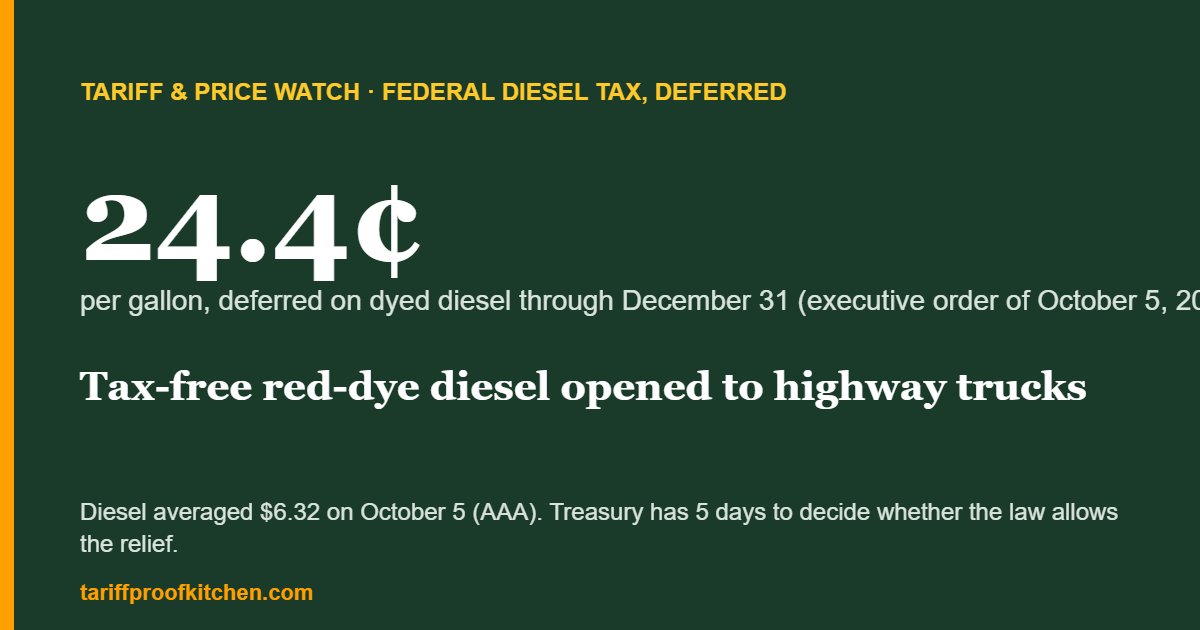
- On October 5, 2026 the president signed an executive order, "Emergency Tax Relief on Diesel Fuel", covering federal tax on dyed diesel used on the highway from October 5 through December 31, 2026.
- The federal diesel tax is 24.4 cents a gallon, about $60 on a 250-gallon fill (White House, October 5). Against AAA's $6.321 average that is 3.9 percent of the pump price.
- The order defers the tax. The Treasury Secretary has 5 days to determine whether 26 U.S.C. 7508A authorizes the relief, and a separate section tells him to look for ways, "including legislation", to cancel the deferred amounts.
- AAA's national average for diesel was $6.321 on October 5, 2026, 20.7 cents below the September 22 record of $6.528 and $2.63 above a year ago.
Key facts
- The executive order "Emergency Tax Relief on Diesel Fuel", signed October 5, 2026, directs the Treasury Secretary to decide within 5 days whether 26 U.S.C. 7508A authorizes relief and, if so, to defer federal excise tax on dyed diesel used on the highway that is incurred from October 5 through December 31, 2026 (White House, October 5, 2026).
- The federal diesel tax is 24.4 cents per gallon, or about $60 on a 250-gallon fill, according to a White House release dated October 5, 2026.
- The order states that deferred amounts carry no penalties or interest, and it directs Treasury to "explore avenues, including legislation, to eliminate the obligation to pay the amounts deferred" (Executive Order, Sec. 2(b) and Sec. 4, October 5, 2026).
- The order does not change any state fuel tax; it directs federal officials to encourage states to adopt matching policies (Executive Order, Sec. 7(b) and Sec. 8, October 5, 2026).
- AAA's national average price for diesel was $6.321 per gallon as of October 5, 2026, compared with $6.453 a week earlier, $3.690 a year earlier and a record $6.528 on September 22, 2026 (AAA Gas Prices, October 5, 2026).
This is a fast-moving story. Prices, tariffs and policy in this brief were correct as of October 6, 2026 and can change from one day to the next; we update when the primary sources do.
What happened
Diesel sold for tractors and construction equipment carries no road tax, and it is dyed red so inspectors can spot it in a highway truck's tank. On Monday night, October 5, the president signed an order aimed at letting highway trucks burn it through the end of the year.
The White House release quotes him, speaking in Nebraska, saying the order would "allow anyone to purchase tax-free red dye diesel for any reason" (White House, October 5, 2026).
The order's text is narrower than that sentence. It tells the Treasury Secretary to determine within 5 days whether an existing tax-postponement law, 26 U.S.C. 7508A, applies. If he finds it does, he "shall, to the extent authorized by law, defer payment" of the federal tax on dyed diesel used on the road between October 5 and December 31. Deferred amounts carry no interest or penalties. Treasury's guidance must name "the date by which postponed taxes must be paid".
Two more pieces matter. The IRS is told to announce, also within 5 days, that it will not penalize highway use of dyed diesel during the period. And Section 4 sends Treasury to look for ways to forgive the deferred tax altogether, which the order itself says may take legislation.
The money is 24.4 cents a gallon. The White House puts that at about $60 on a 250-gallon fill. At AAA's October 5 average, the same fill costs about $1,580.
What has not happened
The tax has not been repealed. A deferral is a bill that arrives later unless Congress or Treasury cancels it, and the order sets no repayment date.
Treasury has not made its determination, as far as we can see. The Federal Register carried nothing on dyed diesel through this morning, and we found no IRS announcement on its news page.
No state tax has changed. The White House says savings "will top $100 per fill" where "states match this federal action". We read no state order, so this brief names no state.
Diesel itself has not moved because of this. AAA's $6.321 is the reading for October 5, and the order was signed that night. EIA's weekly diesel survey is due today, October 6.
No source we found puts a number on what the order does to grocery prices. The fact sheet says it lowers costs and gives no food figure.
Which foods are exposed
| Food | Why it is exposed | Domestic fallback |
|---|---|---|
| Lettuce, broccoli, strawberries (California) | Longest refrigerated haul; Salinas-Watsonville to Chicago was $6,600 to $6,900 a load on September 29 (USDA AMS) | Cabbage, carrots, frozen broccoli and berries |
| Milk and eggs | Delivered by diesel truck every week; no source we found puts a number on the fuel share | Store brands, larger packs |
| Beef and pork | Cattle and boxed meat move by truck | Whole chickens, dried beans |
| Flour, rice, canned goods | Farm diesel is already untaxed, so the order changes little at the field | Buy by the case when the unit price drops |
What to do this month
Leave the October grocery budget where it is. The federal piece is 3.9 percent of a gallon, and it reaches only trucks that can find dyed fuel and choose to use it.
Keep buying produce by distance. The USDA truck report dated September 30 had California loads to Chicago up 18 percent in a week, and one tax deferral does not undo that. The next report is due October 7.
I am watching two dates: Treasury's answer, due within 5 days of October 5, and the first AAA reading after it.
The monthly numbers behind this brief, USDA forecast, BLS shelf prices and diesel, are on the food prices 2026 tracker.
Editorial note: this brief was drafted with AI assistance from the sources below and checked by our editor before publication. Read How we work.
Sources
- White House, Oct 5, 2026 — Executive Order "Emergency Tax Relief on Diesel Fuel"
- White House, Oct 5, 2026 — Release: action to lower diesel costs for truckers and farmers
- White House, Oct 5, 2026 — Fact sheet: diesel affordability
- AAA, as of Oct 5, 2026 — National average fuel prices
- USDA AMS, Sept 30, 2026 — Specialty Crops National Truck Rate Report (FVWTRK)
- EIA, Sept 29, 2026 — Gasoline and Diesel Fuel Update
- Federal Register, queried Oct 6, 2026 — Document search for "dyed diesel", October 1-6, 2026
Frequently Asked Questions
See What This Does to Your Bill
Run the free Tariff Grocery Calculator: 12 questions, your Tariff Exposure Score and the swaps that cut it. Then the full 90-day system for $7.99.
Run the Calculator (free)