Diesel is $6.34, 18 cents under its record, and no export order exists. What that means for October groceries
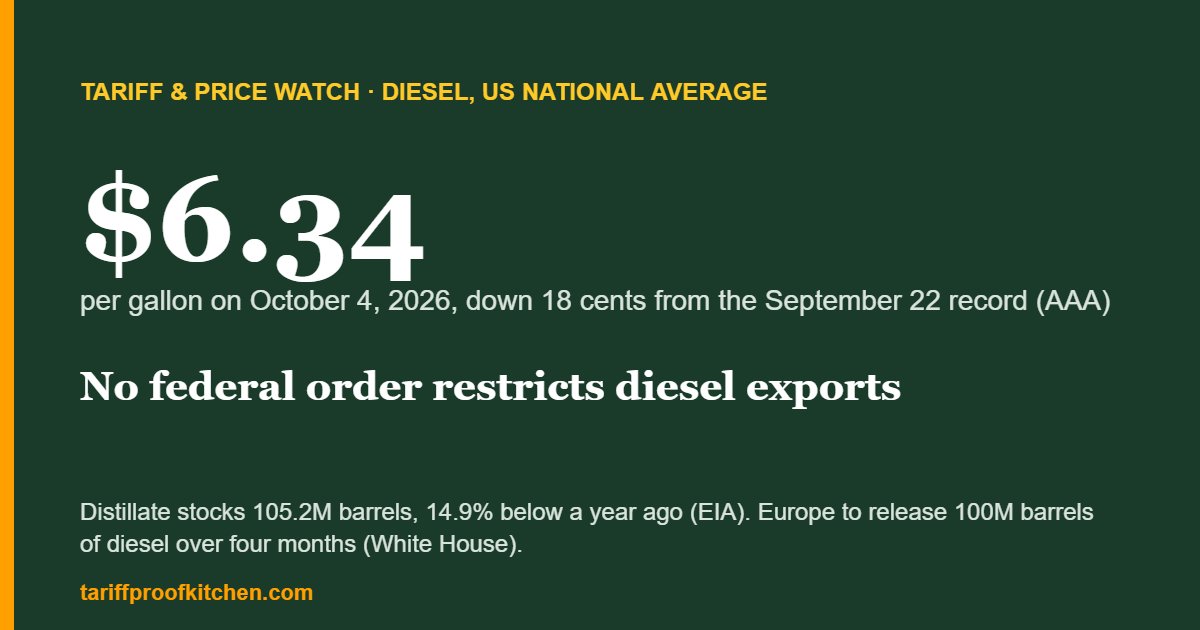
- AAA's national average for diesel was $6.343 a gallon on October 4, 2026, the twelfth day below the record of $6.528 set on September 22, and $2.65 above a year ago.
- Europe is to release 100 million barrels of refined diesel from strategic reserves within the next four months, according to a White House fact sheet dated October 5, 2026.
- US distillate stocks were 105.2 million barrels on September 25, 14.9 percent below a year earlier, and exports ran at 1.529 million barrels a day (EIA, released September 30).
- A refrigerated load of produce from Salinas-Watsonville to Chicago was $6,600 to $6,900 on September 29, up 18 percent in a week (USDA AMS). The next report is due October 7.
Key facts
- AAA's national average price for diesel was $6.343 per gallon as of October 4, 2026, compared with $6.471 a week earlier, $5.850 a month earlier, $3.695 a year earlier and a record $6.528 on September 22, 2026 (AAA Gas Prices, October 4, 2026).
- AAA's national average for regular gasoline was $4.370 per gallon as of October 4, 2026, down 11 cents from $4.480 a week earlier (AAA Gas Prices, October 4, 2026).
- No presidential action or Federal Register document restricting US diesel or distillate exports had been published as of October 5, 2026 (White House Presidential Actions index and Federal Register, checked October 5, 2026).
- US distillate fuel oil stocks were 105.2 million barrels on September 25, 2026, against 123.6 million on September 26, 2025, and US distillate exports were 1.529 million barrels per day in the week ending September 25, 2026 (EIA weekly series, released September 30, 2026).
- USDA's Economic Research Service forecasts fresh vegetable prices to rise 5.7 percent in 2026, in a range of 4.3 to 7.2 percent, and all food at home to rise 2.4 percent (Food Price Outlook, September 25, 2026).
This is a fast-moving story. Prices, tariffs and policy in this brief were correct as of October 5, 2026 and can change from one day to the next; we update when the primary sources do.
What happened
Diesel has been below its record for twelve days. AAA had $6.343 on Sunday, October 4, after $6.355 on Saturday and $6.471 a week earlier. The record, $6.528, was set on September 22.
The supply news is a reserve release. A White House fact sheet dated October 5 says the president "successfully negotiated with Europe to release 100 million barrels of refined diesel from its strategic reserves within the next four months" (White House, October 5, 2026). For scale, our arithmetic: 100 million barrels spread over four months is about 820,000 barrels a day. EIA counted 1.529 million barrels a day of US distillate exports in the week ending September 25.
The paperwork shows no export ban. The White House has posted one presidential action since September 29, a proclamation for National Manufacturing Day. The Federal Register carries nothing on diesel or distillate exports through this morning.
The supply numbers are a week old and still tight. EIA's last weekly release, on September 30, put distillate stocks at 105.2 million barrels, down from 107.4 million the week before and from 123.6 million a year earlier. The next release is Wednesday, October 7.
What has not happened
Diesel is not cheap. $6.343 is 49 cents above a month ago, and a year ago the same gallon was $3.695. EIA's weekly survey for September 28 had the Midwest at $6.526 and California at $8.181.
We have no official price for this week yet. EIA publishes its next diesel survey on October 6. Its Brent series stops at September 29, when crude was $113.96 a barrel, so this brief carries no crude price for the days after the announcement.
Freight has not followed fuel down in any report we can read. The latest USDA truck report, for September 29, showed California vegetable loads to Chicago up 17 to 19 percent in a week, with trucks in slight shortage. Whether that reversed will be in the report dated October 7.
No grocery price index reflects any of this. USDA's latest reading is August: fresh vegetables down 0.8 percent from July and 2.6 percent above August 2025. September CPI is not out. No source we found puts a number on how much of an 18-cent drop in diesel reaches a shelf tag, or how fast.
Which foods are exposed
| Food | Why it is exposed | Domestic fallback |
|---|---|---|
| Lettuce, broccoli, strawberries (California) | Longest truck haul to Midwest and East; Salinas to Chicago $6,600 to $6,900 a load on September 29 (USDA AMS) | Cabbage, carrots, frozen broccoli and berries |
| Fresh vegetables overall | ERS forecasts +5.7% for 2026, the range is 4.3 to 7.2% | Regional fall crops: potatoes, onions, winter squash |
| Fresh fruit | ERS forecasts +2.5% for 2026 | Apples from your own region, where there are orchards |
| Milk and eggs | Move by refrigerated truck every week; no source we found puts a number on the fuel share | Store brands; a gallon instead of two half gallons |
| Rice, beans, canned tomatoes | Shipped by the truckload and the railcar, bought rarely | Buy by the case when the unit price drops |
What to do this month
Keep October's grocery budget where September's was. A gallon of diesel that costs 18 cents less than its record still costs $2.65 more than last October, and the only truck rates we can read are from September 29.
Buy produce by distance for another two weeks. I am staying with cabbage at the per-pound price and one bag of salad greens a week until the October 7 truck report shows which way California rates went.
Leave the pantry plan alone. Nothing in this week's news is a reason to stock up, and nothing in it is a reason to stop.
The monthly numbers behind this brief, USDA forecast, BLS shelf prices and diesel, are on the food prices 2026 tracker.
Editorial note: this brief was drafted with AI assistance from the sources below and checked by our editor before publication. Read How we work.
Sources
- AAA, as of Oct 4, 2026 — National average fuel prices
- White House, Oct 5, 2026 — Fact sheet: diesel affordability (100 million barrels of refined diesel from European reserves)
- EIA, Sept 29, 2026 — Gasoline and Diesel Fuel Update
- EIA, Sept 30, 2026 — Weekly U.S. Ending Stocks of Distillate Fuel Oil
- EIA, Sept 30, 2026 — Weekly U.S. Exports of Total Distillate
- EIA, Sept 30, 2026 — Europe Brent Spot Price FOB
- USDA AMS, Sept 30, 2026 — Specialty Crops National Truck Rate Report (FVWTRK)
- USDA ERS, Sept 25, 2026 — Food Price Outlook, Summary Findings
- White House, checked Oct 5, 2026 — Presidential Actions index
- Federal Register, queried Oct 5, 2026 — Document search for "diesel export" and "distillate", October 1-5, 2026
Frequently Asked Questions
See What This Does to Your Bill
Run the free Tariff Grocery Calculator: 12 questions, your Tariff Exposure Score and the swaps that cut it. Then the full 90-day system for $7.99.
Run the Calculator (free)