Diesel dips to $6.41, but a truckload of California lettuce to Chicago cost 18% more in a week
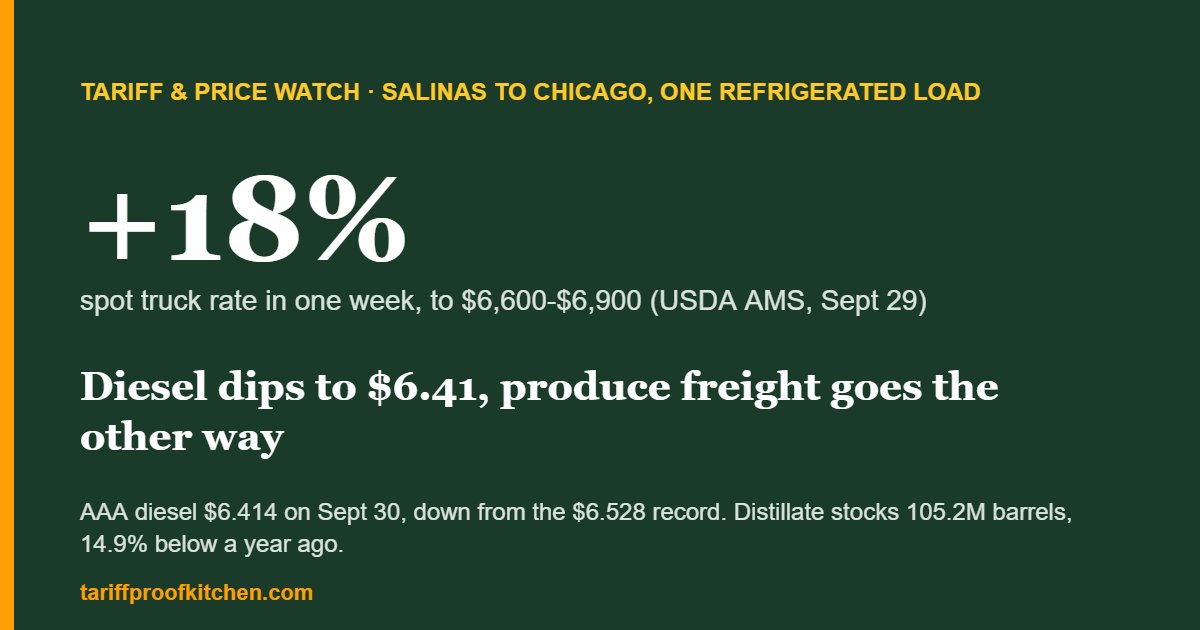
- AAA's national average for diesel was $6.414 a gallon on September 30, 2026, down 2.5 cents in a day and 11.4 cents below the record of $6.528 set on September 22.
- Spot truck rates for produce went the other way. USDA's report for September 29 puts a refrigerated load from Salinas-Watsonville to Chicago at $6,600 to $6,900, up 18 percent from September 22.
- US distillate stocks fell 2.3 million barrels to 105.2 million in the week ending September 25, which is 14.9 percent below a year earlier (EIA, released September 30).
- Distillate exports rose to 1.529 million barrels a day from 1.331 million the week before. No federal order restricts them.
Key facts
- AAA's national average price for diesel was $6.414 per gallon as of September 30, 2026, compared with a record $6.528 on September 22, 2026, $5.604 a month earlier and $3.700 a year earlier (AAA Gas Prices, September 30, 2026).
- The spot rate for a refrigerated truckload of lettuce, broccoli, cauliflower or strawberries from Salinas-Watsonville, California to Chicago was $6,600 to $6,900 on September 29, 2026, up 18 percent from September 22 (USDA AMS Specialty Crops National Truck Rate Report, September 30, 2026).
- US distillate fuel oil stocks were 105.2 million barrels on September 25, 2026, down from 107.4 million on September 18 and from 123.6 million on September 26, 2025 (EIA weekly series, released September 30, 2026).
- US exports of total distillate were 1.529 million barrels per day in the week ending September 25, 2026, up from 1.331 million in the week ending September 18 (EIA weekly series, released September 30, 2026).
- The Brent crude spot price was $113.96 per barrel on September 29, 2026, down from $119.97 on September 28 and from $130.80 on September 15 (EIA, released September 30, 2026).
This is a fast-moving story. Prices, tariffs and policy in this brief were correct as of October 1, 2026 and can change from one day to the next; we update when the primary sources do.
What happened
Diesel kept sliding. AAA had $6.414 on September 30, after $6.439 the day before and $6.522 a week earlier. EIA's Monday survey was $6.382 on September 28, down 14.7 cents on the week and $2.628 above the same week of 2025.
The truck market did not follow. USDA's Agricultural Marketing Service surveys what shippers pay on the spot market for a 48 to 53 foot refrigerated trailer, and its report for Tuesday, September 29 shows Chicago-bound loads up sharply from every California vegetable district: Salinas-Watsonville $6,600 to $6,900 (up 18 percent in a week), Santa Maria $7,500 to $7,900 (up 17 percent), the South and Central district $7,600 to $8,000 (up 19 percent). Carrots from Kern County to Chicago rose 10 percent.
The East Coast picture is mixed. Santa Maria to New York was $10,300 to $10,800, up 6 percent, and to Miami $11,500 to $12,400, up 14 percent. Salinas to New York slipped 2 percent to $9,900 to $10,400. AMS rates truck availability as "slight shortage" across the California vegetable districts and "shortage" for Washington apples and pears, where a load from Yakima to New York ran $11,700 to $15,000.
Underneath, the fuel supply got tighter. EIA's September 30 data show distillate stocks down 2.3 million barrels to 105.2 million, the lowest since August 28. Refiners made 5.003 million barrels a day, down from 5.159 million. Domestic use was 3.948 million barrels a day and exports were 1.529 million.
What has not happened
No export restriction is in force. The newest items on the White House Presidential Actions page are dated September 29 and none concerns fuel. The Federal Register published nothing on diesel or distillate exports through September 30.
Crude did not climb back to its high. Brent was $113.96 on September 29, against $130.80 on September 15.
The freight jump has not appeared in any official grocery price yet. USDA's latest reading is food at home unchanged from July to August 2026 and 2.2 percent above August 2025. September CPI is not out. No source we found puts a number on how much of an 18 percent rise in a spot truck rate reaches the shelf price of a head of romaine, and AMS covers spot loads only, so produce moving under contract may be paying something different.
Which foods are exposed
| Food | Why it is exposed | Domestic fallback |
|---|---|---|
| Lettuce, broccoli, cauliflower, strawberries (California) | Chicago loads up 17 to 19 percent in a week; trucks in slight shortage | Cabbage, carrots, frozen broccoli and berries |
| Apples and pears (Washington) | Yakima to New York $11,700 to $15,000 a load; trucks in shortage | Apples grown in your own region, where there are orchards |
| Citrus (California) | AMS lists truck shortage; rates unchanged on the week | Frozen orange juice concentrate, Florida fruit later in the fall |
| Carrots (Kern County) | Chicago and New York loads up 10 percent | A 5 lb bag keeps for weeks in the fridge |
| Tomatoes, peppers, limes (Mexico via South Texas) | Rates fell to Dallas (down 7 percent) and New York (down 6 percent); trucks in slight surplus on most lanes | Canned tomatoes for cooking |
| Dry goods and canned food | Not covered by the AMS produce report; weekly diesel fell 14.7 cents | Rice, beans, canned tomatoes by the case |
What to do this month
Buy produce by distance. In the Midwest and the East, October apples, potatoes, onions, cabbage and winter squash come from closer than Salinas, and they keep for weeks. I am holding salad greens to one bag a week and buying cabbage at the store's per-pound price for slaw.
Use the freezer aisle for the California crops. Frozen broccoli and berries do not depend on this week's truck, and the sale price on a 12 oz bag is printed on the shelf tag.
Make no change on the strength of export headlines. There is no order and no date.
The monthly numbers behind this brief, USDA forecast, BLS shelf prices and diesel, are on the food prices 2026 tracker.
Editorial note: this brief was drafted with AI assistance from the sources below and checked by our editor before publication. Read How we work.
Sources
- AAA, as of Sept 30, 2026 — National average fuel prices
- USDA AMS, Sept 30, 2026 — Specialty Crops National Truck Rate Report (FVWTRK)
- EIA, Sept 29, 2026 — Gasoline and Diesel Fuel Update
- EIA, Sept 30, 2026 — Weekly U.S. Ending Stocks of Distillate Fuel Oil
- EIA, Sept 30, 2026 — Weekly U.S. Exports of Total Distillate
- EIA, Sept 30, 2026 — Weekly U.S. Refiner and Blender Net Production of Distillate
- EIA, Sept 30, 2026 — Weekly U.S. Product Supplied of Distillate
- EIA, Sept 30, 2026 — Europe Brent Spot Price FOB
- USDA ERS, Sept 25, 2026 — Food Price Outlook, Summary Findings
- White House, checked Oct 1, 2026 — Presidential Actions index
- Federal Register, queried Oct 1, 2026 — Document search for "diesel export" and "distillate export"
Frequently Asked Questions
See What This Does to Your Bill
Run the free Tariff Grocery Calculator: 12 questions, your Tariff Exposure Score and the swaps that cut it. Then the full 90-day system for $7.99.
Run the Calculator (free)