Diesel fell to $6.20 on October 5, the second weekly drop. EIA's new forecast keeps it above $6 through October, so freight-heavy groceries stay expensive.
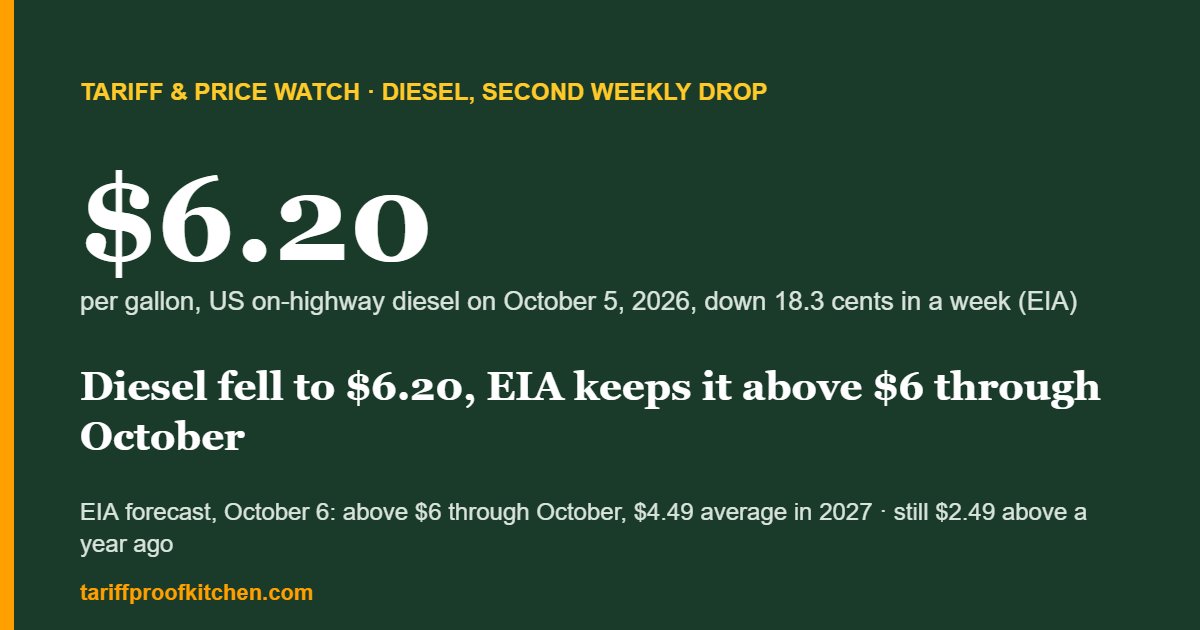
- US on-highway diesel averaged $6.199 a gallon on October 5, 2026, down 18.3 cents in a week and 33 cents below the $6.529 of September 21 (EIA, released October 6).
- It is still $2.488 above the same week last year, which works out to 67 percent higher.
- EIA's Short-Term Energy Outlook of October 6 says diesel "will remain above $6/gal in October" and then ease, averaging $5.19 for 2026 and $4.49 for 2027.
- EIA raised its Brent crude forecast for the fourth quarter to $105 a barrel, $14 higher than a month ago.
Key facts
- The US average on-highway diesel price was $6.199 per gallon on October 5, 2026, down 18.3 cents from $6.382 on September 28 and up $2.488 from a year earlier (EIA Gasoline and Diesel Fuel Update, released October 6, 2026).
- EIA forecasts that retail diesel "will remain above $6/gal in October and then come down gradually", and that low inventories will keep it above $4 a gallon through 2027 (EIA Short-Term Energy Outlook, October 6, 2026).
- EIA expects retail diesel to average $5.19 per gallon in 2026 and $4.49 in 2027, up from $5.07 and $4.40 in its September forecast (EIA Short-Term Energy Outlook, October 6, 2026).
- EIA forecasts Brent crude at $105 per barrel in the fourth quarter of 2026, $14 above its September forecast, after Brent averaged $114 in September (EIA Short-Term Energy Outlook, October 6, 2026).
- AAA's national average for diesel was $6.315 per gallon as of October 6, 2026, 21.3 cents below the record $6.528 set on September 22, 2026 (AAA Gas Prices, October 6, 2026).
This is a fast-moving story. Prices, tariffs and policy in this brief were correct as of October 7, 2026 and can change from one day to the next; we update when the primary sources do.
What happened
Two EIA releases landed on Tuesday, October 6. The weekly pump survey put diesel at $6.199, a second straight weekly decline. The Midwest fell the most, 24 cents to $6.286. California slipped 9.9 cents and still pays $8.082.
The monthly outlook explains why the drop is slow. September diesel averaged $6.29, pushed up by crude and by refinery margins. Brent averaged $114 a barrel that month and touched $131 on September 15 after attacks on Saudi Arabia's East-West pipeline. East Coast distillate stocks ended September 32 percent below their five-year seasonal average.
From here EIA sees a gradual decline. Diesel stays above $6 in October, comes down with crude, and averages $4.49 next year. The agency raised nearly every price in the forecast compared with September: Brent for 2026 went from $91 to $96, and diesel for 2026 from $5.07 to $5.19.
AAA's daily number tells the same story at a slower pace. It was $6.315 on October 6, half a cent lower than the day before.
What has not happened
Diesel has not gone back to anything like last year. A year ago AAA had it at $3.679.
The forecast does not include last week's policy moves. EIA closed its model on October 1 and says the outlook "does not account for any additional crude oil or petroleum products on the market as a result of the G7's announcement on October 2". It also predates the October 5 executive order on dyed diesel.
That order has produced no guidance yet. Treasury had 5 days from October 5 to decide whether it can defer the 24.4-cent federal tax. As of this morning the Federal Register carried nothing on dyed diesel, and we found no IRS announcement.
Produce freight has not been repriced. The USDA truck report online this morning is still the September 30 edition. A new one is due today.
No source we found puts a number on how much of an 18-cent diesel drop reaches a grocery shelf.
Which foods are exposed
| Food | Why it is exposed | Domestic fallback |
|---|---|---|
| Lettuce, broccoli, strawberries (California) | Longest refrigerated haul; Salinas-Watsonville to Chicago was $6,600 to $6,900 a load on September 29, up 18% in a week (USDA AMS), and California diesel is $8.082 | Cabbage, carrots, frozen vegetables and berries |
| Apples, pears, potatoes (Northwest) | Cross-country trucks; West Coast diesel outside California is $6.490 (EIA, October 5) | Regional fruit in season, larger bags |
| Milk and eggs | Delivered by diesel truck every week; no source we found puts a number on the fuel share | Store brands, larger packs |
| Beef and pork | Cattle and boxed meat move by truck | Whole chickens, dried beans |
What to do this month
Plan October as if freight costs stay where they are. EIA's own forecast has diesel above $6 for the rest of the month, and a 5 percent drop from the peak leaves it 67 percent above last fall.
Keep buying produce by distance. Cabbage, carrots, onions and apples from your own region ride fewer miles than a clamshell of California berries.
Leave room in the freezer for late November. If EIA is right about a gradual decline, freight-heavy items are the first place it would show, and frozen vegetables bought on a real markdown keep.
I am watching three things this week: today's USDA truck report, Treasury's answer on dyed diesel, and the September CPI in mid-October.
The monthly numbers behind this brief, USDA forecast, BLS shelf prices and diesel, are on the food prices 2026 tracker.
Editorial note: this brief was drafted with AI assistance from the sources below and checked by our editor before publication. Read How we work.
Sources
- EIA, Oct 6, 2026 — Gasoline and Diesel Fuel Update
- EIA, Oct 6, 2026 — Short-Term Energy Outlook
- EIA, Oct 6, 2026 — Short-Term Energy Outlook, Petroleum Products
- EIA, Oct 6, 2026 — Short-Term Energy Outlook, Global Oil Markets
- AAA, Oct 6, 2026 — AAA Gas Prices, national averages
- USDA AMS, Sep 30, 2026 — Specialty Crops National Truck Rate Report (FVWTRK)
- The White House, Oct 5, 2026 — Executive Order "Emergency Tax Relief on Diesel Fuel"
- The White House, Oct 5, 2026 — President Trump Takes Decisive Action to Lower Diesel Costs for American Truckers, Farmers
- Federal Register, Oct 1-7, 2026 — Document search for "dyed diesel", publication dates October 1-7, 2026
Frequently Asked Questions
EIA's weekly survey put the US average at $6.199 a gallon on October 5, 2026. AAA's daily average was $6.315 on October 6. The two surveys use different samples, so they rarely match to the cent.
EIA's October 6 outlook says retail diesel stays above $6 in October and then comes down gradually. It gives a 2026 average of $5.19 and a 2027 average of $4.49, and it warns that short-term prices may swing more than the forecast shows.
No source we found puts a number on it. Diesel is 5.1 percent below its September 21 level and 67 percent above a year ago, so we plan on current shelf prices through October.
No. EIA finished the forecast on October 1, 2026. It says the outlook does not account for the G7 announcement of October 2, and the dyed-diesel order was signed on October 5.
See What This Does to Your Bill
Run the free Tariff Grocery Calculator: 12 questions, your Tariff Exposure Score and the swaps that cut it. Then the full 90-day system for $7.99.
Run the Calculator (free)