September CPI: grocery prices slipped 0.1% while gasoline jumped 9.1%, and what your cart does next
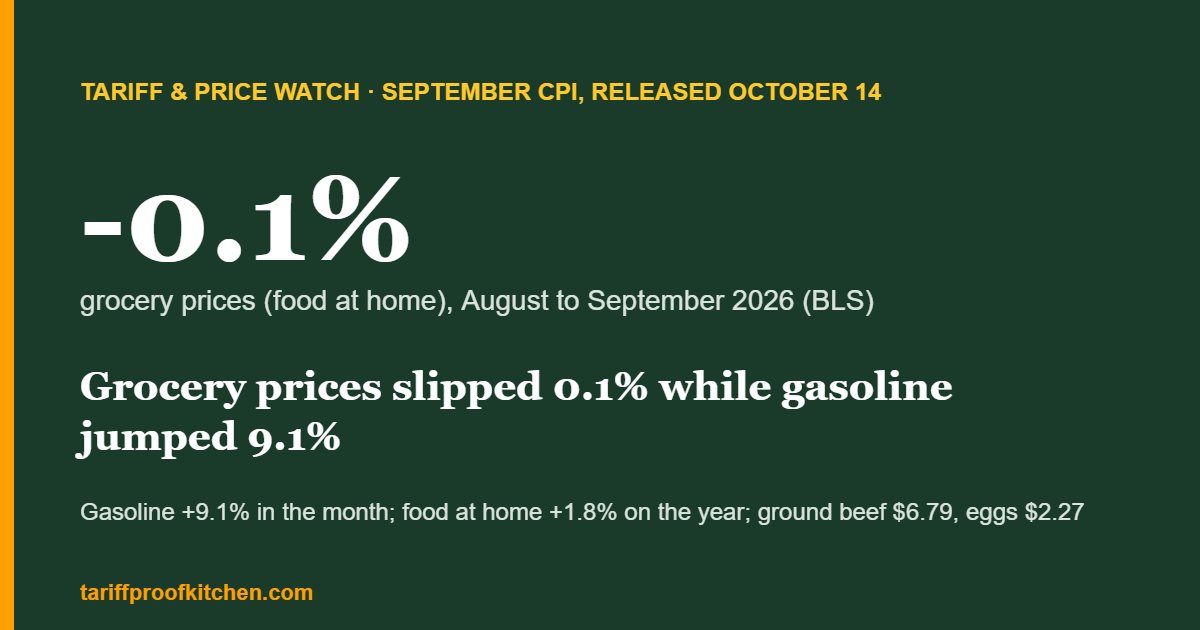
- The Bureau of Labor Statistics said on October 14 that the food at home index fell 0.1% in September and stands 1.8% above September 2025. The all-items CPI rose 0.6% on the month and 3.7% on the year.
- Gasoline rose 9.1% in September alone and accounted for more than half of the monthly increase. Fuel oil is up 74.2% over 12 months; energy overall is up 20.4%.
- Beef (-1.0%), milk (-2.0%) and eggs (-1.3%) pulled the grocery index down in September. Fruits and vegetables (+0.5%) and nonalcoholic beverages (+0.9%) went the other way.
- BLS average prices for September: ground beef $6.79 a pound (down from $6.92 in August, up from $6.32 a year ago), a dozen large eggs $2.27 (down from $3.49 a year ago), a gallon of whole milk $4.11.
Key facts
- The U.S. food at home index decreased 0.1% in September 2026 and increased 1.8% over the 12 months ending September, according to the BLS Consumer Price Index release of October 14, 2026.
- The CPI gasoline index rose 9.1% in September 2026, accounting for over half of the monthly all-items increase of 0.6%, per the BLS release of October 14, 2026.
- The CPI fuel oil index rose 74.2% over the 12 months ending September 2026, and the energy index rose 20.4%, per BLS Table A published October 14, 2026.
- The BLS average price of ground beef was $6.792 per pound in September 2026, down from $6.923 in August 2026 and up from $6.323 in September 2025 (BLS average price data, series APU0000703112, released October 14, 2026).
- The BLS average price of a dozen grade A large eggs was $2.272 in September 2026, unchanged from August and down from $3.488 in September 2025 (series APU0000708111, released October 14, 2026).
This is a fast-moving story. Prices, tariffs and policy in this brief were correct as of October 15, 2026 and can change from one day to the next; we update when the primary sources do.
What happened
The September CPI landed on October 14 and the headline belongs to the pump: a 0.6% monthly rise in all items, the largest since April, with gasoline up 9.1% in one month and 34.2% over the year. The grocery aisle told a different story. Food at home fell 0.1%, its second decline in three months, and the 12-month rate eased to 1.8%, below the 2.5% rate for all food and well below the 3.5% rate for restaurants.
Three of the six grocery groups fell. Meats, poultry, fish and eggs dropped 0.5%, led by beef at -1.0%. Dairy fell 0.9%, with milk down 2.0%. "Other food at home" (the center aisles) slipped 0.2%. Three groups rose: nonalcoholic beverages +0.9% (carbonated drinks +1.5%), fruits and vegetables +0.5%, and cereals and bakery +0.1%.
The BLS average price file gives the dollar figures we track for a family of four. Ground beef averaged $6.792 a pound in September, 13 cents below August's $6.923 and the first monthly drop since May; it is still 47 cents, or 7.4%, above September 2025. A dozen large eggs averaged $2.272, the same as August and 34.9% below the $3.488 of a year earlier. Whole milk averaged $4.106 a gallon, 12 cents below August. Bacon averaged $6.756, down from $7.290 a year ago. Boneless chicken breast averaged $4.203, up 3 cents on the year.
On the 12-month view, the categories still running hot are the ones that travel or depend on imports: coffee +7.1%, rice +7.1%, apples +7.5%, fish and seafood +6.9%, tomatoes +6.8%. Eggs are -20.6% on the year.
What has not happened
September's diesel surge is not yet visible in grocery prices as a category. The CPI measures what shoppers paid at the register during the month; freight contracts, retailer pricing cycles and inventory on hand all sit between a $6 gallon of diesel and a shelf tag. The produce lines that rose in September (lettuce +3.9%, tomatoes +1.4%, bananas +1.0%) are consistent with higher trucking costs, but the BLS release does not attribute them to fuel, and no source we found puts a number on how much of September's produce move was freight.
Diesel has not come down meaningfully either. AAA's national average was $6.2997 on October 14, 22.8 cents below the September 22 record of $6.5276 and $2.64 above a year ago. The EIA's weekly survey price was $6.179 on October 12, down 2.0 cents on the week. Truck rates out of Salinas to Chicago were $8,750-9,250 per load on October 13 per USDA AMS, up 4% on the week; Yakima apple loads are still listed as a truck shortage. The ERS forecast for 2026 grocery inflation stays at 2.4% (September 25 outlook); the next ERS update is due around October 24 and the October CPI on November 10.
Which foods are exposed
| Food | Why it is exposed | Domestic fallback |
|---|---|---|
| Lettuce, tomatoes, bananas | Fresh produce +0.5% in September; lettuce +3.9%, tomatoes +1.4%, bananas +1.0%; long-haul refrigerated freight on $6 diesel | Cabbage, carrots, frozen vegetables; regional fall produce (apples are the exception, +7.5% y/y) |
| Coffee | +7.1% over 12 months, +0.9% in September; fully imported | Store-brand ground coffee, buy the 30 oz canister on promotion |
| Rice | +7.1% over 12 months; part imported (jasmine, basmati) | US long-grain rice, 20 lb bag |
| Fish and seafood | +6.9% over 12 months; largely imported | Canned tuna and salmon, US catfish, frozen US shrimp when on sale |
| Ground beef | $6.79/lb, -1.9% on the month, +7.4% on the year | 73/20 family packs, chicken thighs ($4.20 boneless breast is flat y/y) |
| Eggs, milk | Eggs $2.27/doz (-34.9% y/y), milk $4.11/gal (-0.6% y/y) | These are the cheap aisle this fall; use them |
What to do this month
Buy beef now rather than later: September's $6.79 ground beef is the first monthly drop since May and the ERS still expects beef and veal up 9.4% for 2026, so a decline is a window, not a trend. Eggs and milk are the cheapest they have been in a year; shift breakfast and baking toward them. Hold off on coffee and rice stock-ups unless you see a real promotion; both are running 7% above last year and neither has turned. For produce, the exposed lines are the ones that ride a refrigerated truck 2,000 miles: lettuce, tomatoes, berries, bananas. Frozen vegetables and canned tomatoes did not move in September and will not move with diesel next week either.
The monthly numbers behind this brief, USDA forecast, BLS shelf prices and diesel, are on the food prices 2026 tracker.
Editorial note: this brief was drafted with AI assistance from the sources below and checked by our editor before publication. Read How we work.
Sources
- BLS, Oct 14, 2026 — Consumer Price Index, September 2026 (USDL-26-1574)
- BLS, Oct 14, 2026 — CPI Table 2, detailed expenditure categories
- BLS, Sep 2026 — Average Price Data, U.S. city average, food, September 2026
- AAA, Oct 14, 2026 — AAA national average gas prices
- EIA, Oct 12, 2026 — Gasoline and Diesel Fuel Update, prices for October 12, 2026
- USDA ERS, Sep 25, 2026 — Food Price Outlook, Summary Findings
- USDA AMS, Oct 14, 2026 — Specialty Crops National Truck Rate Report (rates for October 13)
Frequently Asked Questions
Slightly. The BLS food at home index fell 0.1% from August to September, with beef, milk and eggs leading the decline. Over 12 months groceries are still 1.8% higher, and restaurants 3.5% higher.
Gasoline. The gasoline index rose 9.1% in September and accounted for more than half of the 0.6% monthly increase in all items. Energy overall is up 20.4% on the year, fuel oil 74.2%.
The BLS average for September 2026 is $6.79 a pound, down from $6.92 in August but up from $6.32 in September 2025. The ERS still forecasts beef and veal prices up 9.4% for the full year.
No source we found puts a number on the lag. Produce lines that travel by refrigerated truck rose in September (lettuce +3.9%, tomatoes +1.4%) while diesel was at its record, but BLS does not attribute those moves to fuel. The October CPI arrives November 10.
See What This Does to Your Bill
Run the free Tariff Grocery Calculator: 12 questions, your Tariff Exposure Score and the swaps that cut it. Then the full 90-day system for $7.99.
Run the Calculator (free)