US-China "30-for-30" tariff lists: no food on the US import side, so groceries stay where they are
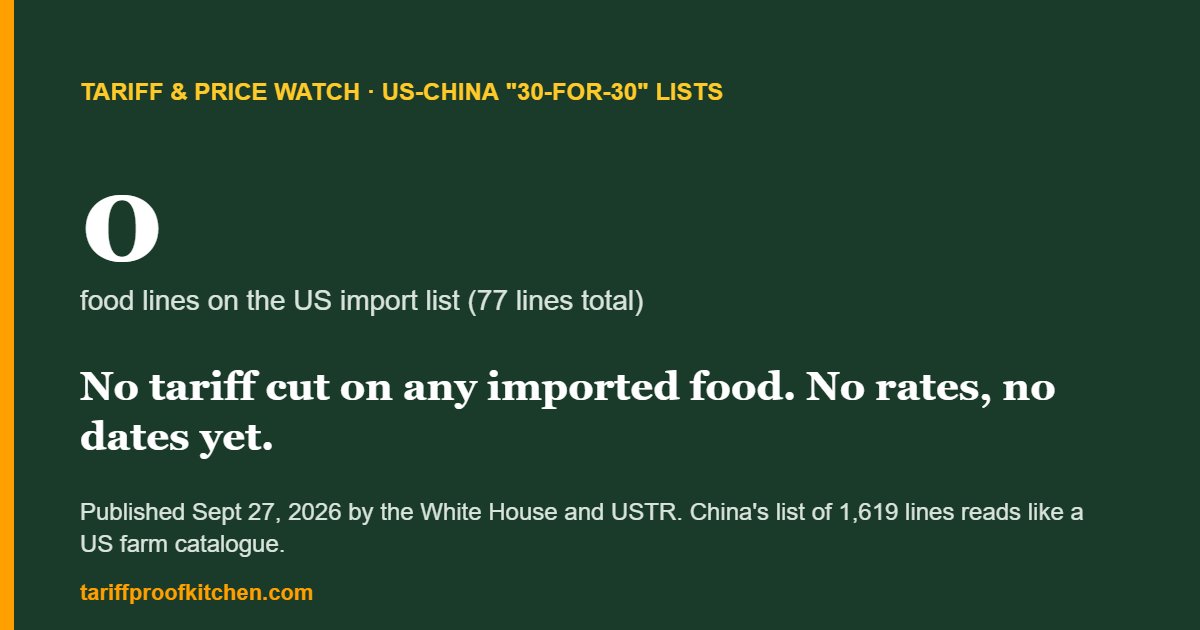
- On September 27, 2026 the White House and USTR published the "30-for-30" product lists: roughly $30 billion of goods in each direction, valued on 2024 trade, recommended for "more favorable tariff treatment in the future."
- The US import list has 77 tariff lines. None is a food, drink or farm product. It is fireworks, tableware, bed linen, toasters, microwaves, coffee makers, toys, balls and fish hooks.
- China's import list has 1,619 lines and reads like a US farm catalogue: beef, pork, chicken, milk powder, cheese, almonds, pistachios, apples, wheat, corn, rice, wine and whiskey.
- No tariff rate has changed. The terms of reference say cuts "will be determined and implemented in accordance with each side's domestic legal processes," with no date.
Key facts
- On September 27, 2026 the Office of the US Trade Representative said the US-China Board of Trade "recommended $30 billion of trade in non-sensitive goods on each side that could benefit from more favorable tariff treatment in the future" (USTR press release, September 27, 2026).
- The US Import List published by the White House on September 27, 2026 contains 77 HTSUS lines and no line from tariff chapters 1 to 24, the chapters that cover food, beverages and agricultural products (White House, US-Public-List.pdf, September 27, 2026).
- China's Import List published the same day contains 1,619 lines, including fresh and frozen beef (HS 0201-0202), pork (0203), chicken and turkey (0207), cheese (0406), almonds and pistachios (0802), apples (0808), wheat (1001), corn (1005), rice (1006) and whiskies (2208) (White House China-Import-List.pdf and USTR unofficial English translation, September 27, 2026).
- The Terms of Reference for the "30-for-30" framework, dated September 27, 2026, state that the two lists were valued "by reference to annual bilateral trade values for calendar year 2024" and that future tariff reductions "will be determined and implemented in accordance with each side's domestic legal processes" (White House, September 27, 2026).
- USDA's Economic Research Service forecast on September 25, 2026 that beef and veal prices will rise 9.4 percent in 2026, pork 1.2 percent and poultry 1.0 percent (USDA ERS Food Price Outlook, September 25, 2026).
This is a fast-moving story. Prices, tariffs and policy in this brief were correct as of September 29, 2026 and can change from one day to the next; we update when the primary sources do.
What happened
Two days after the state visit, both governments put the paperwork online. The White House release of September 27 links four documents: working procedures for the Board of Trade, terms of reference for what the two sides call the "30-for-30" framework, a US Import List and a China Import List. USTR added an unofficial English translation of the Chinese list the same day.
We read all four. The US list is short, 77 lines, and it is household goods: plastic plates and cups (lines 2 and 3), bed and table linen, food processors and juicers (line 26), microwave ovens (34), coffee and tea makers (35), toasters (36), Christmas ornaments, toys, playing cards, soccer balls, fish hooks and vacuum flasks. Toys with Wi-Fi or Bluetooth are excluded.
China's list is long, 1,619 lines, and much of the first 700 lines is meat, dairy, seafood, nuts, fruit and grain. Beef appears fresh, chilled and frozen. Pork appears as carcasses, hams, shoulders and bellies. Chicken appears whole, in cuts, as wings and as frozen chicken claw. Milk powders, five cheese lines, almonds, walnuts, pistachios, fresh apples, wheat, corn, long-grain rice, soybean oil, wine and whiskies are all there. One detail we checked twice: the only soybean line under heading 1201 is 12011000, "soya beans for cultivation." Commercial soybeans do not appear on the list as published.
Ambassador Jamieson Greer's statement of September 27 frames it as "improved market access for about 30 percent of U.S. exports to China, while benefiting consumers with imports from China of household goods, toys, and other products that the United States generally does not import from other countries."
What has not happened
No tariff rate moved on September 27 or since. The terms of reference are explicit: the lists are recommendations, and "future tariff reductions involving the products on the two approved lists will be determined and implemented in accordance with each side's domestic legal processes." No document names a rate, a percentage cut or an effective date. The White House Presidential Actions index shows no tariff proclamation between September 24 and 28.
Nothing on the US list is something you eat. Garlic, apple juice concentrate, tilapia, tea, spices and canned mandarins from China are not on it, so whatever duty they carry today, they carry tomorrow. The lists can be revised, but the two sides "do not envision making adjustments more frequently than on an annual basis."
And no source we found puts a number on how much US beef, pork or chicken China would actually buy under lower tariffs. The White House fact sheet of September 25 mentions "commitments on agricultural and energy purchases" and a working group on farm market access, and gives a tonnage figure only for coal.
Which foods are exposed
| Food | Why it is exposed | Domestic fallback |
|---|---|---|
| Beef (ground, roasts) | On China's import list; more export demand can firm US prices, which USDA already sees +9.4% in 2026 | Chuck and round on sale, whole chickens, dried beans |
| Pork (hams, bellies, shoulders) | On China's list in six lines; USDA sees pork +1.2% in 2026, so the base is calm | Pork shoulder, turkey |
| Chicken (wings, leg quarters, paws) | Wings and "chicken claw" listed separately; wing demand from export can lift wing prices | Whole birds, thighs, eggs (USDA: eggs -29.4% in 2026) |
| Cheese and milk powder | Five cheese lines plus four milk-powder lines on China's list | Store-brand block cheese, dairy forecast +0.1% |
| Almonds, pistachios, walnuts | All three on China's list; US is the main grower | Peanuts, sunflower seeds |
| Imported foods from China (garlic, tilapia, apple juice, tea) | Not on the US list; no cut proposed | US garlic (California), catfish, domestic juice |
What to do this month
Do nothing to your grocery plan because of these lists. They change no price at the register in October. If you were waiting for a cheaper microwave, toaster or coffee maker from China, the lists are a signal, not a sale; there is no date, so buy on need, not on the headline.
Beef is the line to watch. USDA already forecasts beef and veal up 9.4 percent this year, and the China list adds potential export pull on top of that. We keep buying chuck on the weekly sale and freezing it in one-pound packs. Pork, chicken and dairy are calm in the USDA numbers and the lists do not change that this month.
Diesel matters more to your cart this week than this deal does. AAA's national average was $6.453 on September 28, off the $6.528 record of September 22 but still $2.77 above a year ago.
The monthly numbers behind this brief, USDA forecast, BLS shelf prices and diesel, are on the food prices 2026 tracker.
Editorial note: this brief was drafted with AI assistance from the sources below and checked by our editor before publication. Read How we work.
Sources
- USTR, Sept 27, 2026 — Ambassador Greer statement on the Board of Trade recommendations
- White House, Sept 27, 2026 — U.S.-China Board of Trade
- White House, Sept 27, 2026 — Terms of Reference for the "30-for-30" Framework
- White House, Sept 27, 2026 — U.S. Import List (77 lines)
- White House, Sept 27, 2026 — China Import List
- USTR, Sept 27, 2026 — China Import List with unofficial English translation
- White House, Sept 25, 2026 — Fact sheet on the China state visit
- USDA ERS, Sept 25, 2026 — Food Price Outlook
- AAA, as of Sept 28, 2026 — National average fuel prices
Frequently Asked Questions
See What This Does to Your Bill
Run the free Tariff Grocery Calculator: 12 questions, your Tariff Exposure Score and the swaps that cut it. Then the full 90-day system for $7.99.
Run the Calculator (free)