Diesel rises to $6.28, the first weekly increase since the September record. Grocery freight stays expensive into the holidays
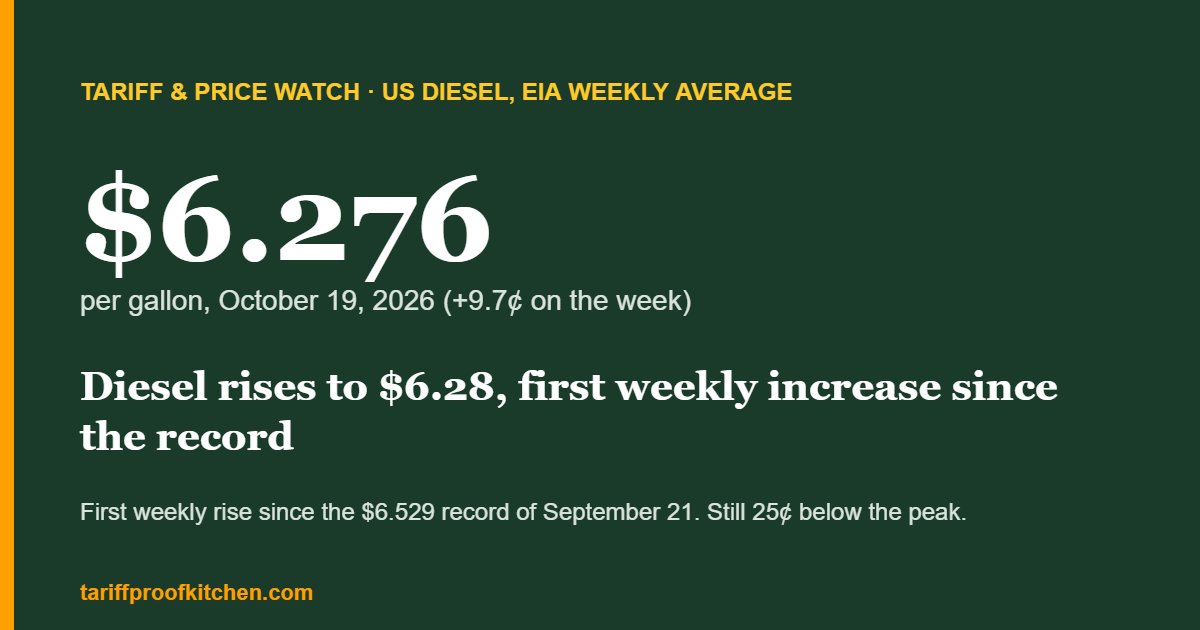
- EIA's weekly US diesel average rose to $6.276 on October 19, 2026, +9.7 cents on the week and +$2.656 on the year; the record is $6.529 on September 21 (EIA Gasoline and Diesel Fuel Update, October 20, 2026).
- The West Coast had the biggest jump: $7.394 (+15.4 cents), with California at $8.242; the Rocky Mountain region rose 12.0 cents to $6.422 and the Midwest 9.3 cents to $6.352 (EIA, October 19, 2026).
- AAA's national average was $6.3199 on October 20, 2026, up 4.1 cents from a week earlier and down 18.5 cents from a month earlier; regular gasoline was $4.2786, down 6.3 cents on the week (AAA, October 20, 2026).
- US distillate stocks were 102,611 thousand barrels in the week ending October 9, 2026, the lowest early-October reading in EIA's weekly series, with exports at 1,373 thousand barrels a day (EIA, released October 15, 2026).
Key facts
- The US on-highway diesel average was $6.276 per gallon on October 19, 2026, up 9.7 cents from October 12 and $2.656 above the same week of 2025 (US Energy Information Administration, Gasoline and Diesel Fuel Update, October 20, 2026).
- The weekly US diesel record is $6.529 per gallon on September 21, 2026, followed by $6.382 on September 28, $6.199 on October 5 and $6.179 on October 12 (US Energy Information Administration weekly series EMD_EPD2D_PTE_NUS_DPG, read October 21, 2026).
- California diesel averaged $8.242 per gallon on October 19, 2026, up 15.1 cents on the week; the Gulf Coast was the cheapest region at $5.903 (US Energy Information Administration, October 20, 2026).
- AAA's national diesel average was $6.3199 per gallon on October 20, 2026, against $3.6192 a year earlier; AAA's highest recorded diesel average is $6.5276 on September 22, 2026 (AAA Gas Prices, October 20, 2026).
- A refrigerated truckload of lettuce or broccoli from Salinas-Watsonville, California to Chicago cost $8,750 to $9,250 on October 13, 2026, up 4 percent from October 6; Salinas to New York was $11,100 to $11,650, up 3 percent (USDA Agricultural Marketing Service, National Truck Rate Report, October 14, 2026).
This is a fast-moving story. Prices, tariffs and policy in this brief were correct as of October 21, 2026 and can change from one day to the next; we update when the primary sources do.
The US average diesel price was $6.276 a gallon on October 19, 2026, up 9.7 cents from the week before (EIA, released October 20). That ends three straight weekly declines from the $6.529 record of September 21. Diesel is still 25 cents under that peak and $2.66 above a year ago. For the refrigerated trucks that move lettuce, apples and milk, the fuel line in the invoice went back up this week after a month of relief. A 48-foot reefer burning roughly 100 gallons on a long haul pays about $10 more for that tank than it did seven days earlier, and about $266 more than last October.
What happened
The weekly EIA survey is the number trucking fuel surcharges are commonly indexed to, and it turned up for the first time in four weeks. The $6.276 reading for October 19 is 9.7 cents above October 12 and sits between the October 5 reading of $6.199 and the September 28 reading of $6.382 (EIA, October 20). Every one of the ten regions EIA reports rose. The East Coast gained 7.6 cents to $5.984, with New England up only 2.9 cents to $6.470 and the Lower Atlantic up 9.5 cents to $5.740. The Midwest, which moves most of the country's grain and meat, rose 9.3 cents to $6.352. The West Coast rose 15.4 cents to $7.394, and California, at $8.242, is now almost $2.34 above the Gulf Coast (EIA, October 19).
AAA's daily number tells the same story with a gentler slope. The national diesel average was $6.3199 on October 20, up from $6.2787 a week earlier but down from $6.5050 a month earlier (AAA, October 20). Regular gasoline kept falling: $4.2786 on October 20, down 6.3 cents on the week and down 19.8 cents on the month. So the family car is getting slightly cheaper to fill while the delivery truck is getting slightly more expensive, which is the pattern we have seen since the Iran war began pulling distillate out of the market.
The supply picture behind the price has not loosened. US distillate inventories stood at 102,611 thousand barrels in the week ending October 9, down 2,527 thousand on the week, with exports of 1,373 thousand barrels a day and refinery distillate production of 5,189 thousand barrels a day (EIA, released October 15). The next inventory report is due the afternoon of October 21. Brent crude, the benchmark for most of the world's diesel, was $126.55 a barrel on October 14, down from $130.03 on October 9 (EIA daily spot).
On the farm-to-store leg, the USDA truck rate report for October 13 shows produce freight still rising, if more slowly than in late September. Salinas to Chicago was $8,750 to $9,250 a load, up 4 percent on the week; Salinas to Philadelphia was up 7 percent at $10,400 to $10,800. Apple shippers in Washington's Yakima Valley reported a truck shortage, with loads to Boston quoted at $11,000 to $16,000 (USDA AMS, October 14). A 3 lb bag of Washington Honeycrisp in a Boston store rides that lane.
What has not happened
Diesel has not returned to its record. At $6.276 the EIA average is 25.3 cents under September 21, and AAA's $6.3199 is 20.8 cents under its September 22 peak.
No new federal fuel action has been taken since the October 5 executive order on diesel taxes. The White House presidential actions, fact sheets and releases indexes list nothing new on fuel between October 16 and October 21, and the Federal Register shows no new presidential document on fuel in that window other than the October 21 publication of the Russia-Iran sanctions order we covered on October 19.
No agency has published a figure for how much of this week's 9.7-cent move reaches a grocery shelf. Fuel surcharges are set contract by contract, and no primary source we found puts a number on the average pass-through to food prices. We are not going to estimate one and call it data.
The USDA's food price forecast has not changed since September 25. It still calls for food-at-home prices up 2.4 percent in 2026, fresh vegetables up 5.7 percent, fresh fruits up 2.5 percent and dairy up 0.1 percent (USDA ERS Food Price Outlook, September 25, 2026). The next update is due in late October.
Which foods are exposed
| Food | Why it is exposed | Domestic fallback |
|---|---|---|
| West Coast lettuce, broccoli, strawberries | Salinas to Chicago at $8,750-9,250 a load on October 13 (+4%), and California diesel at $8.242 | Frozen vegetables packed in the Midwest; Florida and Arizona desert lettuce as the season shifts in November |
| Washington apples and pears | Yakima Valley reports a truck shortage; loads to Boston $11,000-16,000 | Michigan, New York and Pennsylvania apples in the Northeast and Midwest; store-brand bagged apples |
| Milk and dairy | Short-haul refrigerated freight on a daily cycle; the ERS still sees dairy prices up only 0.1% in 2026 | Regional dairies; store-brand gallons, which move on the shortest routes |
| Bottled water, juice, canned goods | Heavy, low-value loads where fuel is a large share of the delivery cost | Tap water with a filter; concentrate; buy cans on the monthly case deal |
| Frozen foods | Reefer trucks burn extra fuel to hold temperature | Shop the freezer case for store brands, which are packed closer to the store |
What to do this month
Buy produce by region, not by habit. A head of romaine in a Chicago store on October 21 rode a $9,000 truck from Salinas; a bag of Michigan apples did not. Our tariff-proof grocery list sorts the fall basket by freight exposure.
Lock in the heavy items on the case deal. Canned tomatoes, beans and broth are the categories where fuel is the largest share of the price and where retailers run monthly promotions. Twelve cans bought once beats one can bought twelve times.
Do not stockpile fresh food on this news. A 9.7-cent move in diesel is about 1.5 percent of the fuel price and a fraction of that on a shelf price. The stockpile guide covers what keeps and what does not.
Check your own basket with the Tariff Grocery Calculator before the next shop.
The monthly numbers behind this brief, USDA forecast, BLS shelf prices and diesel, are on the food prices 2026 tracker.
Editorial note: this brief was drafted with AI assistance from the sources below and checked by our editor before publication. Read How we work.
Sources
- EIA, Oct 20, 2026 — Gasoline and Diesel Fuel Update, release date October 20, 2026
- EIA, weekly — Weekly U.S. No 2 Diesel Retail Prices, series EMD_EPD2D_PTE_NUS_DPG
- AAA, Oct 20, 2026 — AAA Gas Prices, national averages
- EIA, Oct 15, 2026 — Weekly U.S. Ending Stocks of Distillate Fuel Oil, week ending October 9, 2026
- EIA, weekly — Weekly U.S. Exports of Distillate Fuel Oil
- EIA, daily — Europe Brent Spot Price FOB, daily
- USDA AMS, Oct 14, 2026 — Specialty Crops National Truck Rate Report, rates for October 13, 2026
- USDA ERS, Sep 25, 2026 — Food Price Outlook, Summary Findings
- The White House, Oct 21, 2026 — Presidential Actions and Fact Sheets indexes
Frequently Asked Questions
One week is not a trend. The EIA average rose 9.7 cents to $6.276 on October 19 after three weekly declines, and it is still 25 cents below the September 21 record. The EIA's October outlook, published October 6, expected diesel to stay above $6 in October and ease after that; the next outlook is due November 10.
Groceries move by truck, and trucks run on diesel. Gasoline fell 6.3 cents on the week to $4.2786 (AAA, October 20) while diesel rose, so the family car got cheaper to run and the delivery truck got dearer. Trucking fuel surcharges are commonly indexed to the EIA weekly diesel number, which is why we lead with it.
Fresh produce on long refrigerated hauls, frozen food, and heavy low-value items like bottled water and canned goods. The USDA truck report for October 13 priced Salinas to Chicago at $8,750 to $9,250 a load and reported a truck shortage for Washington apples. Dairy and bread move short distances and feel it least.
Not on fuel. The last federal action is the October 5 executive order on diesel taxes; the White House indexes and the Federal Register show nothing new on fuel through October 21. The $8 billion Harvest Fuel Relief program announced October 19 pays farmers for 2026 crop losses and does not change pump prices.
See What This Does to Your Bill
Run the free Tariff Grocery Calculator: 12 questions, your Tariff Exposure Score and the swaps that cut it. Then the full 90-day system for $7.99.
Run the Calculator (free)