The 100% tariff on Russian-oil buyers was set, then waived, on October 16. Shrimp and basmati stay where they were
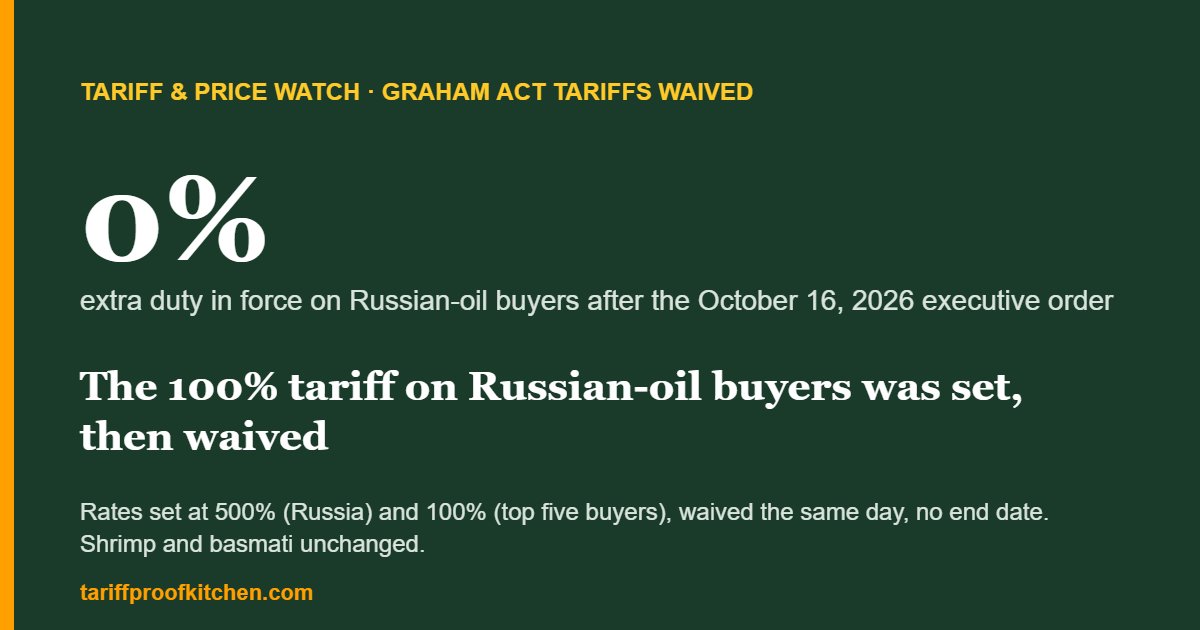
- October 16, 2026: executive order "Implementing the Lindsey O. Graham Sanctioning Russia and Iran Act of 2026" signed; Sec. 2 sets rates of 500% (Russia) and 100% (top five Russian-oil buyers, top five evasion facilitators); Sec. 4(a) waives "any duties provided for in sections 112 and 113 of the Graham Act or this order" (whitehouse.gov, October 16).
- The 100% duty would have applied to a top-five buyer that "knowingly makes new purchases ... on or after October 18, 2026", which is 30 days after the Act was signed on September 18 (executive order Sec. 2(b); H.R. 5334 Sec. 113(c), govinfo.gov).
- No country is named in the order. The U.S. Trade Representative is told to monitor Russian crude and gas purchases and report back; the waiver lasts until the President or the Secretary of State decides "further action is appropriate" (executive order Sec. 3, 4(d)).
- Diesel was $6.3224 a gallon on October 18, up 4.5 cents on the week and 20.5 cents below the September 22 record of $6.5276 (AAA, October 18). EIA's Brent spot was $126.55 on October 14, the latest day published (eia.gov).
Key facts
- On October 16, 2026, President Trump signed an executive order under Section 115 of the Lindsey O. Graham Sanctioning Russia and Iran Act of 2026 that waives "the application of any duties provided for in sections 112 and 113 of the Graham Act or this order" (whitehouse.gov, Presidential Actions, October 16, 2026).
- The same order, in Section 2, sets the rate of duty on goods from Russia at an additional 500% ad valorem and the rate on goods from the five largest importers of Russian crude oil and natural gas at an additional 100% ad valorem for any such country that "knowingly makes new purchases" on or after October 18, 2026, before waiving both (whitehouse.gov, October 16, 2026).
- Section 115(b) of H.R. 5334 requires the President, before any waiver, to submit to Congress "a certification in writing that the issuance of the waiver is in the national interests of the United States" and "a report explaining the basis for the certification"; the order states that both were submitted (enrolled text, govinfo.gov; executive order Sec. 1, October 16, 2026).
- As of October 19, 2026, no country has been designated as a top-five buyer of Russian oil or gas, and no USTR notice implementing the Act has appeared in the Federal Register (Federal Register API, documents dated October 15-19, 2026).
- The U.S. average price of white long-grain rice was $1.118 per pound in September 2026, up from $1.060 a year earlier (BLS average price data, series APU0000701312, September 2026).
This is a fast-moving story. Prices, tariffs and policy in this brief were correct as of October 19, 2026 and can change from one day to the next; we update when the primary sources do.
On October 16, two days before the Graham Act's 30-day clock ran out, the President signed an executive order that does two things in one page. Section 2 sets the duties the law demands: 500% on goods from Russia, 100% on goods from the five largest buyers of Russian crude and gas that keep buying "on or after October 18, 2026", and 100% on the five top facilitators of sanctions evasion. Section 4 then waives all of them, with no end date (whitehouse.gov, October 16). For the grocery aisle this is the outcome we flagged as possible on September 20: no new duty on Indian shrimp, basmati, cumin or tea, and nothing new on Chinese tilapia or garlic. White long-grain rice, the BLS benchmark, was $1.118 a pound in September, 5.8 cents above a year earlier (BLS).
What happened
The Act gave the President 30 days from September 18 to raise duties on the top five buyers of Russian crude and gas "to a rate of up to 100 percent" (H.R. 5334, Sec. 113(a), govinfo.gov). Our September 20 brief read that "shall" as mandatory and the rate as open. The October 16 order resolves it in a way we did not list: the rate is set at the ceiling, 100%, and the duty is waived at the same time. Section 115(a) of the Act allows the President to waive "any duty under this title" once a national-interest certification goes to Congress, and Section 1 of the order says that certification was sent (whitehouse.gov, October 16).
The waiver is broad. Section 4 covers the duties in Sections 112 and 113, the sanctions provisions in Sections 102 through 111 and 117, and anything in the order itself. It carves out one thing: the existing Russia sanctions under the national emergency continued on March 24, 2026, which the order says are not affected (Sec. 4(b)). So the sanctions already in place on Russian entities stand; the new ones from the September law are paused.
What stays live is the machinery. Section 3 tells the Trade Representative, with State, Treasury and Energy, to monitor who is buying Russian crude and gas and who is helping Russia dodge sanctions, and to "promptly inform the President of any circumstance that ... might indicate the need for further action by the President, including with respect to the waivers" (whitehouse.gov, October 16). Section 5 delegates the Section 113 tariff power to USTR and the Section 115 waiver power to the Secretary of State. The Act itself adds a second clock: 180 days after any duty is first imposed, and every 180 days after that, USTR must redraw the top-five lists (Sec. 113(e)). Since no duty has been imposed, that clock has not started.
The order gives no reason for the waiver. The certification to Congress is the document that would explain it, and it is not public. We have read press accounts that tie the decision to Russian diesel supplies, but no primary page we could open confirms that, so we leave it there.
Fuel, meanwhile, moved little over the weekend. Diesel was $6.3224 on October 18 (AAA), 4.5 cents above a week earlier and 12.5 cents below a month earlier. EIA's Brent spot, published with a lag, was $126.55 on October 14 against $130.03 on October 9 (eia.gov).
What has not happened
No tariff is being collected under the Graham Act. The 500% and 100% rates exist on paper in Section 2 of the order and are waived in Section 4 of the same order (whitehouse.gov, October 16).
No country has been named. The order speaks of "the largest 5 importers" and "the top 5 facilitators" without listing them, and nothing in the Federal Register for October 15-19 designates anyone (Federal Register API).
Existing duties on Indian and Chinese food have not changed. Whatever rate applied to Indian shrimp or Chinese tilapia on October 15 applied on October 19; the order neither raises nor lowers them.
The waiver has no expiry. Section 4(d) says it holds "until such time as the President or the Secretary of State ... determine that further action is appropriate". That could be next week or never. No source we found puts a date on it.
The question of whether food was ever covered is still open. Section 114(a) of the Act exempts "the provision of agricultural commodities, food, medicine" from "sanctions and other measures under this title". The order does not say whether that clause would have shielded shrimp and rice from a Section 113 duty, and with the duty waived, nobody has had to decide.
Which foods are exposed
Disclaimer: the import shares below (Indian shrimp, basmati) are the analyst and industry figures we used on September 20, not official US statistics, and we have not matched them against NOAA or USITC tables. The legal facts come from the order and the enrolled Act, read directly. The exposure now is to a reversal of the waiver, not to a duty in force.
| Food | Why it is exposed | Domestic fallback |
|---|---|---|
| Frozen shrimp | India supplied about 37.7% of US shrimp imports in 2025 (analyst figure); a waiver reversal would reach the freezer case in weeks | Gulf wild-caught shrimp; Ecuador is the top supplier and is not a Russian-oil buyer |
| Basmati rice | India shipped about 274,000 t to the US in FY2025 (industry figure); US white long-grain was $1.118/lb in September (BLS) | Texas and Arkansas long-grain; Thai jasmine |
| Spices (cumin, turmeric, chili) | India is a top-three source; whole seeds keep 2-3 years, so there is no reason to rush | Store brands blend origins; buy whole, grind at home |
| Tea | India and China are the two largest US sources | Argentine black tea in many store brands |
| Tilapia, garlic | China is the largest frozen-tilapia supplier; no current share figure in hand | US catfish, Alaska pollock; Gilroy garlic |
What to do this month
Nothing new. The threat that was 30 days out on September 20 has been set and waived in the same document, and the monitoring that could reverse it has no deadline. If you bought the 10 lb bag of basmati on our earlier advice, it keeps for a year; you lost nothing. If you did not, there is no price reason to buy it this week rather than next.
The one line worth a glance is still shrimp, because frozen inventory turns fast. Keep the origin label habit: Ecuador and the US Gulf on one side, India on the other. A reversal would show in the Indian bags first.
Diesel is the bigger cart factor by far, and it is a separate story. At $6.32 a gallon it is 74% above a year ago (AAA, October 18), which is why wholesale truck freight was up 19.3% on the year in the September PPI we covered on October 16. Our grocery list already favors heavy, long-haul items bought in bulk once rather than weekly.
The monthly numbers behind this brief, USDA forecast, BLS shelf prices and diesel, are on the food prices 2026 tracker.
Editorial note: this brief was drafted with AI assistance from the sources below and checked by our editor before publication. Read How we work.
Sources
- The White House, Oct 16, 2026 — Executive Order "Implementing the Lindsey O. Graham Sanctioning Russia and Iran Act of 2026"
- U.S. Government Publishing Office, Sep 18, 2026 — H.R. 5334 enrolled text, Sections 112-117
- The White House, Oct 19, 2026 — Presidential Actions index
- Federal Register, Oct 15-19, 2026 — Documents published October 15-19, 2026, search term "tariff"
- AAA, Oct 18, 2026 — AAA national average gas and diesel prices
- EIA, Oct 14, 2026 — Europe Brent spot price FOB, daily
- BLS, Sep 2026 — Average Price Data, rice (APU0000701312) and ground beef (APU0000703112)
- Tariff & Price Watch, Sep 20, 2026 — Trump signed a law allowing 100% tariffs on Russian-oil buyers (our earlier brief)
Frequently Asked Questions
No. The October 16 executive order sets a 100% rate on goods from the five largest buyers of Russian oil and gas and then waives it in the same document. No country has been named and no duty is being collected.
The Act told the President to raise the duty within 30 days of September 18 and separately let him waive it after certifying a national-interest reason to Congress. The order does both, which satisfies the law. The certification that explains the reason has not been published.
Yes. The waiver lasts until the President or the Secretary of State decides "further action is appropriate", and USTR is told to keep monitoring Russian oil and gas purchases. There is no date attached.
Not on this news. Rice, whole spices and tea keep for a year or more, so a large bag bought earlier was not wasted, and there is no reason to buy more now. Our calculator shows what any given rate would do to your weekly basket if the waiver were reversed.
See What This Does to Your Bill
Run the free Tariff Grocery Calculator: 12 questions, your Tariff Exposure Score and the swaps that cut it. Then the full 90-day system for $7.99.
Run the Calculator (free)