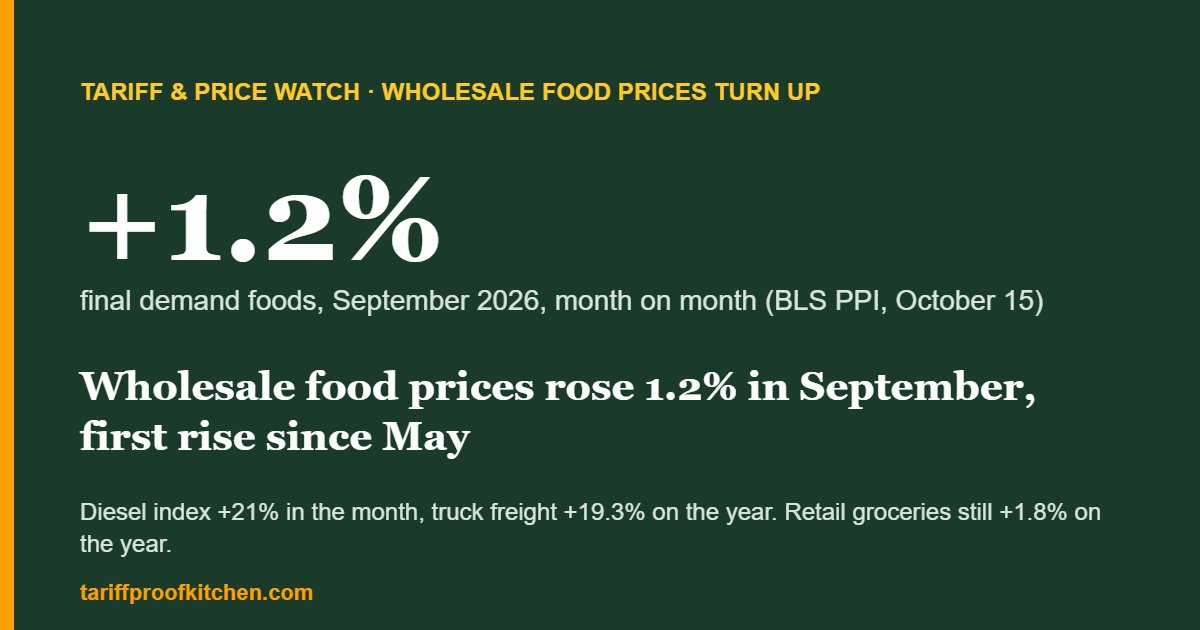
Wholesale food prices rose 1.2% in September, the first rise since May. Diesel and trucking are why your grocery bill may follow.
- The Producer Price Index for final demand rose 1.3% in September, the biggest monthly jump since March 2022, and 6.3% over the year (BLS, October 15).
- Wholesale food prices (final demand foods) rose 1.2% in September after falling in June, July and August. Over 12 months they are flat, 0.0% (BLS table 2).
- The diesel fuel index rose 21.0% in September alone and is up 115.2% from a year earlier; truck transportation of freight rose 3.8% on the month and 19.3% on the year (BLS table 2).
- Pump diesel is drifting back up: AAA put the national average at $6.317 on October 15, up 1.8 cents on the day and 4.8 cents on the month, 21 cents under the September 22 record.
Key facts
- The U.S. Bureau of Labor Statistics reported on October 15, 2026 that the Producer Price Index for final demand increased 1.3 percent in September 2026, seasonally adjusted, the largest advance since March 2022, and 6.3 percent over the 12 months ended September.
- BLS table 2 of the September 2026 PPI release shows the index for final demand foods up 1.2 percent from August and unchanged (0.0 percent) from September 2025.
- BLS table 2 of the September 2026 PPI release shows the index for truck transportation of freight up 3.8 percent in September and 19.3 percent over the 12 months ended September 2026, and the No. 2 diesel fuel index up 21.0 percent on the month and 115.2 percent on the year.
- BLS table 2 of the September 2026 PPI release shows fresh and dry vegetables up 41.0 percent in September and 29.6 percent over the year, while eggs for fresh use fell 31.9 percent on the month and 66.0 percent on the year.
- AAA's national average for diesel was $6.317 a gallon on October 15, 2026, against a year-ago $3.655 and a record $6.528 set on September 22, 2026.
This is a fast-moving story. Prices, tariffs and policy in this brief were correct as of October 16, 2026 and can change from one day to the next; we update when the primary sources do.
What happened
September's producer price report, out Thursday October 15, is the first one that shows the diesel shock moving into the food pipeline. Final demand foods, the wholesale price of food headed to stores, restaurants and the government, rose 1.2% in the month after three straight declines. The index for crude finished consumer foods, which is mostly fresh produce and eggs at the farm gate, rose 13.8%.
Most of that came from vegetables. The fresh and dry vegetables index rose 41.0% in September and sits 29.6% above a year earlier. Fresh fruits and melons rose 3.7% on the month and 9.1% on the year. Grains rose 17.4% and oilseeds 11.4%, both more than 27% above September 2025. Prepared animal feeds, which set the cost of raising chickens and hogs, rose 2.3% on the month and 6.6% on the year.
The freight side is the part that reaches every aisle. Truck transportation of freight rose 3.8% in September and 19.3% over 12 months. Food and alcohol wholesaling margins rose 6.7%. Diesel at the producer level rose 21.0% in one month and has more than doubled on the year. BLS said nearly half of the rise in processed goods for intermediate demand "can be traced to a 21.0-percent increase in prices for diesel fuel".
Pump prices stopped falling this week. AAA's diesel average was $6.317 on October 15, up from $6.300 the day before and $6.285 a week earlier. Brent crude was $126.55 on October 14 by EIA's daily series, above the $113.96 of late September. EIA's weekly inventory report for the week ending October 9 shows distillate stocks at 102.6 million barrels, down 2.5 million on the week and 12.3% below the 117.0 million of a year earlier. Exports eased to 1,373,000 barrels a day from 1,764,000 the week before.
What has not happened
Retail food prices have not moved yet. The September CPI, released October 14, had the food index unchanged for the month, food at home down 0.1% and food away from home up 0.2%. Grocery prices are up 1.8% over the year, well under the 3.7% headline rate. Wholesale food is flat over 12 months too, at 0.0%, because meat and eggs are cheaper than a year ago: pork -19.4%, processed young chickens -12.5%, beef and veal -3.6%, eggs for fresh use -66.0%, dairy products -0.6%. Raw milk fell 12.3% in September alone.
No new federal action on diesel or food tariffs appeared between October 14 and the morning of October 16. The White House presidential actions index still ends with the October 5 diesel tax order; the Federal Register carries no diesel-tax, beef-quota or tariff document for those dates; and the IRS has posted nothing after its October 14 penalty-relief release. Treasury's deferral guidance, which the October 5 order said should come within five days, is still unpublished as of this writing.
A 1.2% rise in one month is not a trend. The same index rose 0.6% in May and then fell for three months. One more report, due November 13, will say whether September was a turn or a blip.
Which foods are exposed
| Food | Why it is exposed | Domestic fallback |
|---|---|---|
| Lettuce, tomatoes, peppers, fresh vegetables | Vegetables index +41.0% in September; Salinas-to-Chicago truck $8,750-9,250 a load (AMS, October 13) | Frozen and canned vegetables; cabbage, carrots, onions, potatoes travel better and move in bulk |
| Bread, pasta, flour, cereal | Grains +31.6% on the year; bakery products still only +2.0% | Store-brand flour and pasta; prices move slowly through this chain |
| Cooking oil | Oilseeds +27.8% on the year; shortening and cooking oils -6.4%, so no pass-through yet | Buy the larger bottle while shelf prices lag the farm price |
| Chicken, pork | Feed +6.6% on the year, but processed chicken -12.5% and pork -19.4% | These are the cheap proteins this fall; freeze family packs |
| Fish and seafood | Finfish and shellfish +20.1% on the year, +9.0% in September | Canned tuna, frozen fillets; shop the weekly ad |
| Eggs | -66.0% on the year at the farm gate; retail $2.27 a dozen in September (BLS) | None needed; eggs are the bargain of the season |
| Anything shipped far | Truck freight +19.3%; paper boxes +4.7%, plastic packaging +5.5% on the year | Regional produce, bulk packs, fewer small-pack purchases |
What to do this month
Buy the cheap proteins while the producer indexes say they are cheap: eggs, chicken, pork, and ground beef, which retailed at $6.79 a pound in September. A 10-pound bag of leg quarters freezes in meal-size bags and covers four dinners.
Expect fresh salad vegetables to be the first retail line to move. Lettuce was already up 3.9% in the September CPI. Frozen spinach, peas and corn, and canned tomatoes, carry the same nutrition and none of the trucking exposure.
Hold off on stocking cooking oil, flour and pasta in bulk. Their farm-level inputs are up sharply, but their shelf prices barely moved in September, so the store price is still the better one.
Watch the November 13 PPI and the November 10 CPI. If final demand foods rise again in October, we expect the grocery CPI to start reflecting it by December.
The monthly numbers behind this brief, USDA forecast, BLS shelf prices and diesel, are on the food prices 2026 tracker.
Editorial note: this brief was drafted with AI assistance from the sources below and checked by our editor before publication. Read How we work.
Sources
- BLS, Oct 15, 2026 — Producer Price Indexes, September 2026, USDL 26-1576
- BLS, Oct 15, 2026 — PPI Table 2, final demand and intermediate demand product detail
- BLS, Oct 15, 2026 — PPI Table 1
- BLS, Oct 14, 2026 — Consumer Price Index, September 2026, USDL-26-1574
- BLS, Oct 14, 2026 — CPI Table 2, September 2026
- BLS, Sep 2026 — Average Price Data, series APU0000703112 (ground beef) and APU0000708111 (eggs)
- USDA ERS, Sep 25, 2026 — Food Price Outlook, summary findings
- AAA, Oct 15, 2026 — AAA Fuel Prices, national averages
- EIA, Oct 14, 2026 — Gasoline and Diesel Fuel Update
- EIA, Oct 9, 2026 — Weekly U.S. Ending Stocks of Distillate Fuel Oil, week ending October 9, 2026
- EIA, weekly — Weekly U.S. Exports of Distillate Fuel Oil
- EIA, Oct 14, 2026 — Europe Brent Spot Price FOB, daily
- USDA AMS, Oct 13, 2026 — Specialty Crops National Truck Rate Report
- The White House, Oct 16, 2026 — Presidential Actions index
Frequently Asked Questions
No. The producer index measures what sellers receive at the first commercial sale, before processing, packaging, trucking and the store's margin. Over 12 months wholesale food is flat while grocery prices are up 1.8%. The two move in the same direction over time, but not month by month.
Eggs for fresh use are down 66.0% from September 2025, when flock losses had pushed prices to records; supply has recovered. Pork is down 19.4% on the year. Retail eggs averaged $2.27 a dozen in September by BLS average prices.
AAA's national average rose from $6.300 on October 14 to $6.317 on October 15 and is 4.8 cents above a month ago, though still 21 cents under the September 22 record. EIA's October forecast had diesel staying above $6 in October and then easing; distillate stocks are 12.3% below last year, so the floor is high.
No. We found no new presidential action, Federal Register document or IRS release on diesel taxes, beef quotas or food tariffs between October 14 and the morning of October 16. The Treasury guidance on deferring the 24.4-cent federal diesel tax is still pending.
See What This Does to Your Bill
Run the free Tariff Grocery Calculator: 12 questions, your Tariff Exposure Score and the swaps that cut it. Then the full 90-day system for $7.99.
Run the Calculator (free)