East Coast diesel stocks fall to the lowest October level since 1990; diesel $6.28
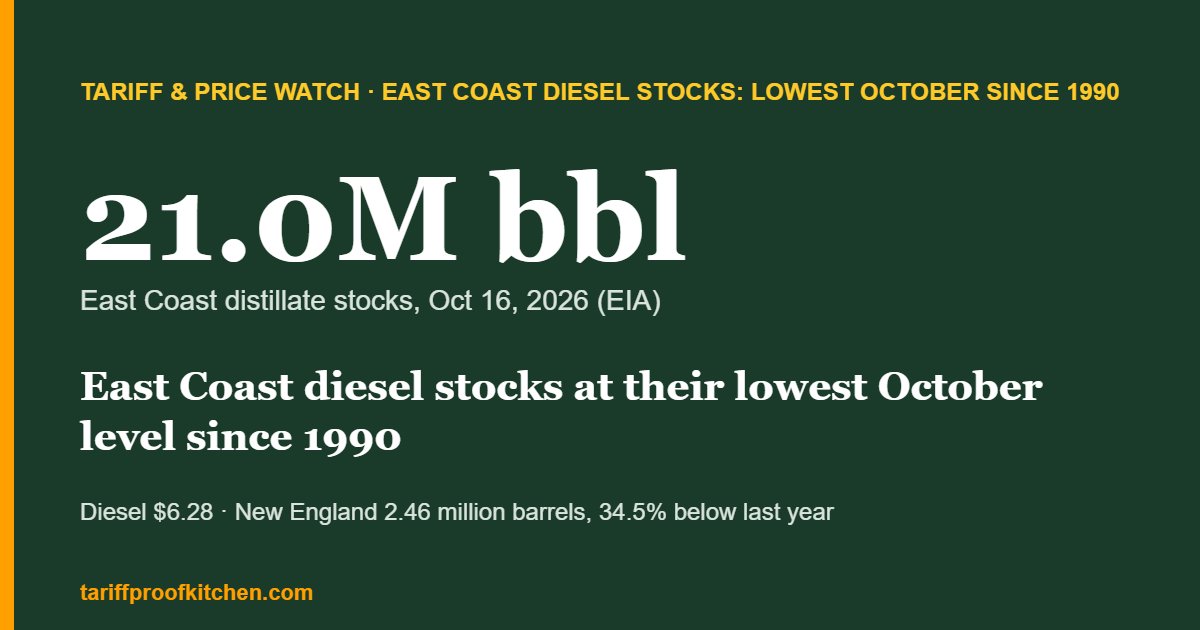
- EIA data released October 21 put East Coast distillate stocks at 21.0 million barrels on October 16, down 21.7% from a year earlier and the lowest reading for the first three weeks of October in a weekly series that starts in 1990. New England held 2.46 million barrels, 34.5% below last year.
- US retail diesel was $6.276 a gallon on October 19 (EIA), up 9.7 cents on the week; AAA had it at $6.3174 on October 21, 21 cents under the September 22 record of $6.5276. Residential heating oil averaged $6.190 on October 19, $2.66 above a year ago.
- USDA's truck rate report dated October 21 shows a Salinas-to-New York produce load at $13,020-13,500 (+17% on the week) and the first Florida tomato loads of the season at $3,100-3,400 to New York.
Key facts
- East Coast (PADD 1) distillate fuel oil stocks were 21,016 thousand barrels in the week ending October 16, 2026, against 26,830 thousand a year earlier and 32,372 thousand two years earlier, according to EIA weekly data released October 21, 2026.
- The US average retail price of on-highway diesel was $6.276 a gallon on October 19, 2026, up from $6.179 on October 12 and below the record $6.529 of September 21, 2026 (source: EIA Weekly Retail Gasoline and Diesel Prices).
- The US average residential heating oil price was $6.190 a gallon on October 19, 2026, up 5.2 cents on the week and $2.664 on the year (source: EIA Heating Oil and Propane Update, October 21, 2026).
- A refrigerated truckload from Salinas-Watsonville, California to New York cost $13,020-13,500 on October 20, 2026, up 17% from October 13 (source: USDA AMS Specialty Crops National Truck Rate Report, October 21, 2026).
This is a fast-moving story. Prices, tariffs and policy in this brief were correct as of October 22, 2026 and can change from one day to the next; we update when the primary sources do.
What happened
Heating oil and highway diesel are the same product, ultra-low sulfur distillate, sold through two different pumps. EIA's weekly inventory report on October 21 showed why the Northeast is the pressure point. East Coast distillate stocks stood at 21.0 million barrels on October 16, down 500,000 barrels on the week and 5.8 million below the same week of 2025. We went through the whole EIA weekly series, which begins in January 1990, and no other reading between October 1 and October 20 of any year is that low. New England alone held 2.46 million barrels, against 3.75 million a year ago and 5.27 million two years ago.
Nationally the picture improved a little: US distillate stocks rose 1.7 million barrels to 104.3 million, still 9.7% below last year. Exports were 1.38 million barrels a day, refiners made 5.23 million barrels a day and the country used 3.73 million.
Prices moved the other way. EIA's Monday survey put diesel at $6.276 on October 19, the second weekly rise in a row after a month of declines. AAA's daily reading was $6.3174 on October 21, up 1.8 cents on the week and $2.70 above a year ago. Residential heating oil cost $6.190 a gallon on October 19, with Maine at $6.026 and New York at $6.417. EIA's Winter Fuels Outlook of October 6 already expected the roughly 3% of US households that heat with oil, most of them in the Northeast, to pay more than 30% higher prices than last winter and about 21% more in total, a milder winter forecast taking some of the edge off.
What has not happened
No diesel has been released for trucks. There is no new White House order on fuel since the October 5 dyed-diesel executive order; we checked the Presidential Actions, Fact Sheets and Releases indexes and the Federal Register's presidential documents through October 22. And the national diesel price, while 21 cents off its record, has now gone up two weeks running. We would not read this week's data as a signal that freight costs are about to fall.
Which foods are exposed
| Food | Why it is exposed | Domestic fallback |
|---|---|---|
| Lettuce, broccoli, strawberries (Salinas, Santa Maria) | Salinas to New York rose 17% in a week to $13,020-13,500; Santa Maria to New York +13% at $12,850-13,745 (USDA AMS, Oct 21) | Cabbage and carrots ship cheaper; Salinas to Chicago fell 42% to $5,090-5,400 as the season winds down |
| Tomatoes | Florida's first loads of the season: $3,100-3,400 to New York, $3,500-4,000 to Boston; Mexico via South Texas to Boston +7% at $6,800-7,500 | Canned and jarred tomatoes bought in the fall; Florida is a short haul to the East Coast |
| Apples and pears (Washington) | Trucks in "slight shortage" to all ten cities; Yakima to Boston $11,000-16,000, to New York $11,300-14,000 | Eastern apples (New York, Pennsylvania, Michigan) in October and November |
| Milk, eggs, frozen foods | Refrigerated and frozen distribution runs on diesel; no source we found puts a number on the pass-through to these items | Store brands; buy larger packs when the unit price is right |
| Anything shipped into New England | Heating oil and diesel draw from the same East Coast tanks, now at their lowest October level since 1990 | Local root vegetables, winter squash, frozen and canned staples |
What to do this month
Buy the Florida tomato season, not the Mexican one, if you live east of the Mississippi: the first USDA rates from Florida to New York are about a quarter of the Salinas rate. Lean on apples from your own state for the next six weeks while Washington trucks stay short. If you heat with oil, ask your dealer now about a fixed-price or budget plan; the EIA numbers say your fuel will cost about $2.66 a gallon more than last winter unless something changes. I keep a 20 lb bag of rice and two cases of canned tomatoes under the stairs; this is the month to top them up.
The monthly numbers behind this brief, USDA forecast, BLS shelf prices and diesel, are on the food prices 2026 tracker.
Editorial note: this brief was drafted with AI assistance from the sources below and checked by our editor before publication. Read How we work.
Sources
- EIA, Oct 21, 2026 — Weekly East Coast (PADD 1) Ending Stocks of Distillate Fuel Oil (also US series WDISTUS1, New England WDIST1A1, Central Atlantic WDIST1B1, exports WDIEXUS2, production WDIRPUS2, product supplied WDIUPUS2)
- EIA, Oct 19, 2026 — Weekly Retail On-Highway Diesel Prices
- EIA, Oct 21, 2026 — Heating Oil and Propane Update, prices for October 19, 2026
- EIA, Oct 6, 2026 — Short-Term Energy Outlook and Winter Fuels Outlook
- AAA, Oct 21, 2026 — AAA national average gas prices
- USDA AMS, Oct 21, 2026 — Specialty Crops National Truck Rate Report
- USDA ERS, Sep 25, 2026 — Food Price Outlook, Summary Findings
Frequently Asked Questions
EIA reported 21.0 million barrels of distillate on the East Coast on October 16, 2026, down 21.7% from a year earlier. We checked every October reading in EIA's weekly series back to 1990 and none for the first three weeks of the month is lower. New England's 2.46 million barrels are 34.5% below last year.
No source we found puts a number on that, and we would not expect it. The national diesel price rose for a second week to $6.276 on October 19. USDA's current forecast is still food-at-home up 2.4% in 2026 and fresh vegetables up 5.7%.
The USDA rate is what a shipper or receiver pays to move one refrigerated trailer of lettuce, broccoli or strawberries from Salinas to New York: $13,020-13,500 on October 20, before the produce itself is paid for. When that rate moves 17% in a week, as it did, the store either absorbs the difference or passes it on within one or two deliveries. No source we found puts a per-pound number on that pass-through.
See What This Does to Your Bill
Run the free Tariff Grocery Calculator: 12 questions, your Tariff Exposure Score and the swaps that cut it. Then the full 90-day system for $7.99.
Run the Calculator (free)