Diesel slipped to $6.30, yet a produce truck from Salinas to Chicago cost 28% more on October 6. New York lanes rose too.
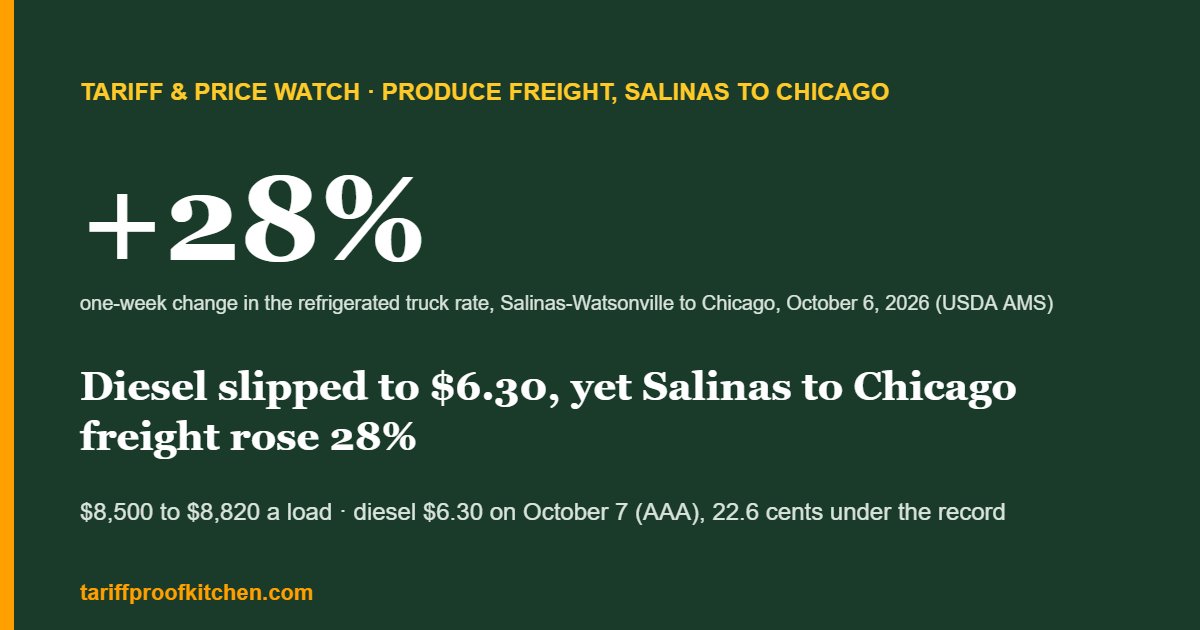
- A refrigerated truckload from Salinas-Watsonville, California, to Chicago cost $8,500 to $8,820 on October 6, 2026, up 28 percent from September 29 (USDA AMS, report of October 7).
- The same origin to New York cost $10,760 to $11,275, up 9 percent, while Baltimore fell 8 percent and Philadelphia 10 percent.
- AAA's national diesel average was $6.3015 on October 7, down 11.2 cents in a week and 22.6 cents below the record $6.5276 of September 22.
- US distillate stocks were 105,138 thousand barrels on October 2, 13.5 percent below a year earlier, and exports rose to 1,764 thousand barrels a day (EIA, released October 7).
Key facts
- The spot rate for a refrigerated truckload of produce from Salinas-Watsonville, California, to Chicago was $8,500 to $8,820 on October 6, 2026, up 28 percent from September 29 (USDA AMS Specialty Crops National Truck Rate Report, October 7, 2026).
- Truck rates from South and Central California to New York were $11,480 to $12,030 a load on October 6, 2026, up 16 percent in a week, while the same district's rate to Chicago fell 9 percent to $6,910 to $7,310 (USDA AMS, October 7, 2026).
- USDA rated truck availability as "Shortage" for apples and pears leaving Washington's Yakima Valley and Wenatchee district on October 6, 2026, with loads to New York at $11,500 to $15,000, unchanged from the week before (USDA AMS, October 7, 2026).
- AAA's national average for diesel was $6.3015 per gallon as of October 7, 2026, against $6.4139 a week earlier and $3.6803 a year earlier (AAA Gas Prices, October 7, 2026).
- US distillate fuel stocks stood at 105,138 thousand barrels in the week ending October 2, 2026, compared with 121,559 thousand a year earlier, and distillate exports were 1,764 thousand barrels a day, up from 1,529 the week before (EIA weekly petroleum data, released October 7, 2026).
This is a fast-moving story. Prices, tariffs and policy in this brief were correct as of October 8, 2026 and can change from one day to the next; we update when the primary sources do.
What happened
USDA's weekly truck report came out on Wednesday, October 7, with rates for Tuesday, October 6. It covers the second week of falling diesel, and the picture is uneven.
The Salinas-Watsonville lane to Chicago is the outlier. It jumped 28 percent to $8,500 to $8,820 a load. Our October 1 brief had the same lane at $6,600 to $6,900 for September 29, after an 18 percent rise that week. Salinas ships lettuce, broccoli, cauliflower and strawberries.
Other California districts went the opposite way into Chicago. Santa Maria fell 10 percent to $6,680 to $7,150, and the Imperial and Coachella valleys fell 9 percent to $6,400 to $6,850. Into New York almost everything rose: Salinas 9 percent, Santa Maria 10, Kern carrots 11, South and Central California vegetables 16.
USDA marks truck supply as "Slight Shortage" on every California vegetable lane and "Shortage" for California citrus and Washington apples.
Fuel kept easing. AAA had diesel at $6.3015 on October 7, 1.4 cents below the day before. EIA's inventory data for the week ending October 2, released the same day, showed distillate stocks flat at 105,138 thousand barrels while exports climbed to 1,764 thousand barrels a day, the highest weekly figure since the week ending August 21.
What has not happened
Cheaper diesel has not produced cheaper produce freight across the board. The fuel is down 22.6 cents from its record, and the Salinas to Chicago truck costs 28 percent more than a week ago. USDA rates truck supply as short on that lane.
Diesel stocks have not rebuilt. They fell by 42 thousand barrels in the week, and they sit 13.5 percent under last year's level.
Treasury has not answered on dyed diesel. The October 5 executive order gave it 5 days to decide whether it can defer the 24.4-cent federal tax, which runs to Saturday, October 10. As of this morning the Federal Register carried nothing, and we found no IRS or Treasury announcement.
No new tariff on food was announced this week. We checked the White House and USTR pages this morning.
No source we found puts a number on how much of a truck-rate change reaches a shelf price.
Which foods are exposed
| Food | Why it is exposed | Domestic fallback |
|---|---|---|
| Lettuce, broccoli, cauliflower, strawberries (Salinas) | Chicago lane up 28% to $8,500-8,820 a load, New York up 9% (USDA AMS, October 6) | Cabbage, frozen broccoli, frozen berries |
| Carrots, celery, citrus (Southern and Central California) | New York lanes up 11% to 16%; citrus trucks in "Shortage" | Regional root vegetables, larger bags |
| Apples and pears (Washington) | Truck "Shortage"; $11,500-15,000 a load to New York, unchanged on the week | Apples from Michigan, New York or your own region |
| Tomatoes, peppers, limes (Mexico via South Texas) | Rates flat, $3,800-4,400 to Chicago, trucks in "Slight Surplus" | The cheaper haul this week; no swap needed |
What to do this month
Shop the short haul. Produce crossing at South Texas reached Chicago for about half the freight of a Salinas load on October 6, so tomatoes, peppers and cucumbers carry less trucking cost than West Coast lettuce right now.
Buy apples from the nearest orchard region. Washington fruit to the East Coast is the most expensive lane in the report, and the Michigan and New York harvests are in stores in October.
Keep frozen vegetables in the plan. A 12-ounce bag of frozen broccoli keeps for months, so a week of expensive trucks does not have to show up in your cart.
I am watching Saturday's Treasury deadline and next Wednesday's truck report.
The monthly numbers behind this brief, USDA forecast, BLS shelf prices and diesel, are on the food prices 2026 tracker.
Editorial note: this brief was drafted with AI assistance from the sources below and checked by our editor before publication. Read How we work.
Sources
- USDA AMS, Oct 7, 2026 — Specialty Crops National Truck Rate Report (FVWTRK)
- AAA, Oct 7, 2026 — AAA Gas Prices, national averages
- EIA, Oct 6, 2026 — Gasoline and Diesel Fuel Update
- EIA, Oct 7, 2026 — Weekly US Ending Stocks of Distillate Fuel Oil
- EIA, Oct 7, 2026 — Weekly US Exports of Total Distillate
- The White House, Oct 5, 2026 — Executive Order "Emergency Tax Relief on Diesel Fuel"
- Federal Register, Oct 1-8, 2026 — Document search for "dyed diesel", publication dates October 1-8, 2026
Frequently Asked Questions
USDA's report does not give a reason. It does show truck supply rated "Slight Shortage" or "Shortage" on every California and Washington lane on October 6, 2026, and fuel is only one part of what a carrier charges.
On October 6, 2026, USDA reported $8,500 to $8,820 a load from Salinas-Watsonville, $6,680 to $7,150 from Santa Maria and $6,400 to $6,850 from the Imperial and Coachella valleys. These are spot rates for 48 to 53 foot refrigerated trailers.
AAA's national average was $6.3015 a gallon as of October 7, 2026. EIA's weekly survey had $6.199 on October 5. The record in AAA's series is $6.5276, set on September 22, 2026.
The executive order was signed on October 5, 2026, and gives Treasury 5 days to decide whether the deferral is authorized. As of October 8 we found no Treasury or IRS guidance, so the terms are not yet known.
See What This Does to Your Bill
Run the free Tariff Grocery Calculator: 12 questions, your Tariff Exposure Score and the swaps that cut it. Then the full 90-day system for $7.99.
Run the Calculator (free)