Diesel $6.31 as Trump signs Defense Production Act refining order: no price relief in the text
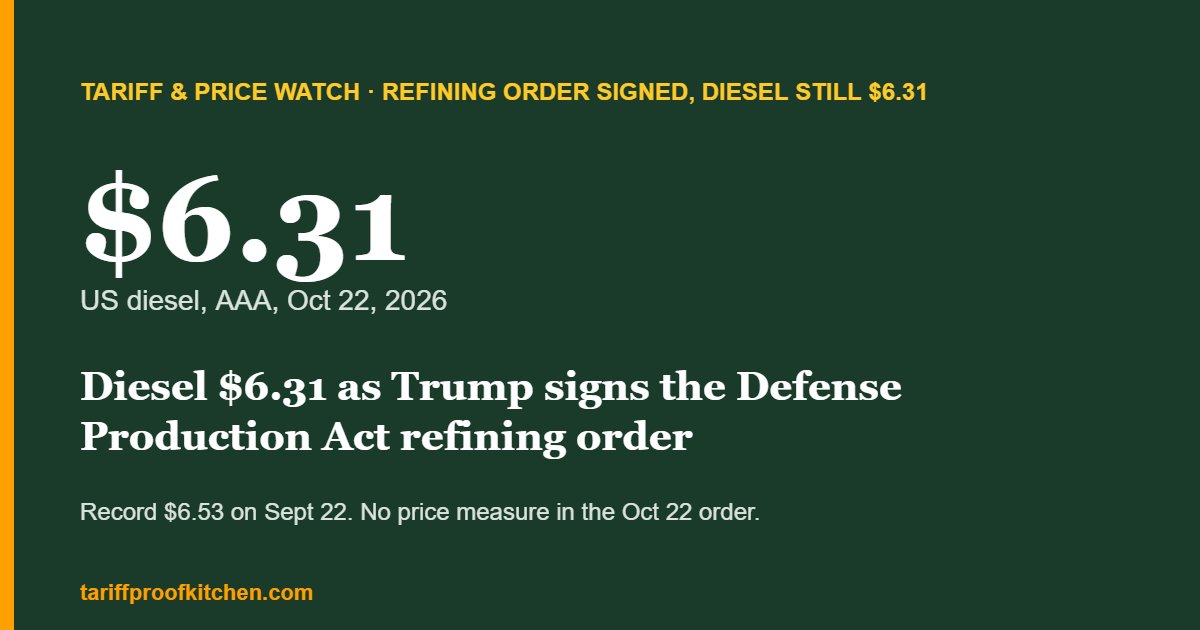
- On October 22, 2026 the president signed a Defense Production Act determination declaring domestic petroleum production, refining and logistics "essential to the national defense" and authorizing the Secretary of War to make purchases and financial commitments to expand them. It names no dollar amount, no project and no date.
- Diesel averaged $6.309 a gallon on October 22 (AAA), 21.9 cents under the September 22 record of $6.528 and $2.68 above a year ago. Regular gasoline was $4.270.
- EIA's weekly survey had diesel at $6.276 on October 19, up 9.7 cents on the week, the second weekly rise in a row after four weeks of declines.
- Produce freight is mixed: a Salinas-to-New York load cost $13,020-13,500 on October 20 (+17% on the week) while Salinas-to-Chicago fell 42% to $5,090-5,400 (USDA AMS, October 21).
Key facts
- On October 22, 2026 the White House published a Presidential Determination under section 303 of the Defense Production Act finding that U.S. petroleum production, refining and logistics capacity are "essential to the national defense" and waiving the Act's usual procedural limits for expanding them (whitehouse.gov, October 22, 2026).
- The U.S. average diesel price was $6.309 per gallon on October 22, 2026, against a record $6.528 on September 22, 2026 and $3.629 a year earlier (AAA, October 22, 2026).
- EIA's weekly on-highway diesel price was $6.276 per gallon on October 19, 2026, up 9.7 cents from October 12 and $2.656 above October 20, 2025 (EIA Gasoline and Diesel Fuel Update, October 19, 2026).
- U.S. refinery utilization averaged more than 95% of capacity from May through September 2026, the highest for those months since 1998, and refining capacity is 4% lower than in 2019 (EIA Today in Energy, October 22, 2026).
- U.S. distillate stocks were 104.3 million barrels in the week ending October 16, 2026, 9.7% below the 115.6 million barrels of a year earlier (EIA Weekly Petroleum Status Report, released October 21, 2026).
This is a fast-moving story. Prices, tariffs and policy in this brief were correct as of October 23, 2026 and can change from one day to the next; we update when the primary sources do.
What happened
The order came late on Thursday, October 22. It is a memorandum to the Secretary of War, not an executive order, and it rests on section 303 of the Defense Production Act of 1950, the part of the law that lets the government buy, guarantee or finance industrial capacity it decides the country needs. The president finds that "domestic petroleum production, refining, and logistics capacity, including exploration and production, gathering and transmission pipelines, storage, and marine terminals" are "essential to the national defense", that industry "cannot reasonably be expected" to add that capacity on its own "due to constrained financing, long lead times, permitting and infrastructure bottlenecks, and supply chain limitations", and he waives the Act's usual procedural requirements. The War Department is "authorized and directed" to implement it, "including making necessary purchases, commitments, and financial instruments to enable these projects".
That is the whole operative text. There is no appropriation attached, no list of projects, no deadline and no mention of retail prices. The determination builds on the national energy emergency declared on January 20, 2025 (Executive Order 14156). What it unlocks is financing authority for refineries, pipelines and terminals, the kind of thing that moves over years, not weeks.
The same day, EIA published an analysis that explains why the administration is looking at refining capacity at all. US refineries ran above 95% of capacity from May through September, the highest for those months since 1998, and EIA says the runs were "driven largely by tight global supplies for distillate fuel oil", meaning diesel and heating oil for export. Even so, total output was only the highest since 2019, because the country has 4% less refining capacity than it did then. Refineries cannot run much harder than they already are. In the first three weeks of October utilization eased from its summer high but stayed above the 2021-2025 average.
At the pump, diesel is drifting rather than falling. AAA put the national average at $6.309 on October 22, down a fraction of a cent on the day and essentially flat on the week ($6.317 a week earlier). It is 21.9 cents off the September 22 record and still $2.68 above October 2025. EIA's weekly survey, taken Monday October 19, showed $6.276, up 9.7 cents on the week and the second rise in a row after the price had slid from $6.529 (September 21) to $6.179 (October 12). The regional spread is wide: $5.903 on the Gulf Coast, $6.352 in the Midwest, $6.508 in the Central Atlantic, $8.242 in California.
Crude is not helping. EIA's daily Brent spot series shows $115.22 on October 20, down from $135.51 on October 2 but far above the $85-95 range of July and August. AAA's own headline on October 22 read "National Average Falls 6 Cents, But Crude Oil Nears $100/Barrel", a reference to the US benchmark.
What has not happened
No new tariff, export restriction or price measure on fuel was published between October 21 and 23. We checked the Federal Register's list of presidential documents and the three White House indexes on the morning of October 23: the only new items are the DPA determination, a proclamation on wind-turbine imports (which orders negotiations, not tariffs) and a housing order. The newest White House fact sheet on diesel is still the October 6 one on the dyed-diesel tax deferral.
The Defense Production Act order does not cap, subsidize or tax diesel. It does not release reserves. It does not change the October 5 dyed-diesel order or the Russian-diesel license.
On Russian diesel, Russian officials have said a first 40,000-tonne cargo would sail for the United States on October 22. No US government page confirms a cargo, a buyer or a port, and we have not read one, so we do not report it as fact.
Nothing in the record puts a number on what the DPA order will cost, build or save. We will say so until a Federal Register notice or a contract award does.
Which foods are exposed
Freight is a small slice of a grocery bill, but it is the slice that moves first when diesel does. Here is where the exposure sits, with the fallback we use at home.
| Food | Why it is exposed | Domestic fallback |
|---|---|---|
| Lettuce, broccoli, strawberries from Salinas | A reefer load to New York cost $13,020-13,500 on October 20, up 17% on the week (USDA AMS) | Fall greens from local growers; frozen broccoli and spinach |
| Tomatoes | Florida's season just opened; first-report rates $3,100-3,400 to New York (USDA AMS, October 21) | Canned tomatoes bought now; Florida and Georgia supply grows through November |
| Apples from Washington | Yakima loads to Boston $11,000-16,000, trucks in slight shortage | Eastern apples (New York, Michigan, Pennsylvania) in season |
| Milk, eggs, bread | Delivered daily by diesel truck; low margin, so haulage shows up fast | Store brands, larger pack sizes |
| Frozen and canned goods | Shipped by rail and truck, but the cost is spread over long shelf life | Buy on promotion, these hold |
What to do this month
Buy the Chicago-bound produce. Salinas loads to Chicago fell 42% in a week to $5,090-5,400 while New York loads rose 17%. If you shop in the Midwest, October lettuce and broccoli cost less to land than on the East Coast. Whether your store passes that on is something only the shelf tag tells you; no source puts a number on it.
Shift to tomatoes from Florida and Georgia rather than Mexico or California over the next four weeks. The season has just opened and AMS lists truck supply as adequate on those lanes.
Put long-life staples on the list while diesel is off its record: rice, pasta, canned beans, oil. The ERS forecast for food at home in 2026 is +2.4% (range 1.8 to 3.0), and fresh vegetables +5.7% (range 4.3 to 7.2). Fresh is where the freight shows; shelf-stable is where it does not.
Do not wait for the DPA order to lower prices. Refining capacity takes years to build, and the text has no date.
The monthly numbers behind this brief, USDA forecast, BLS shelf prices and diesel, are on the food prices 2026 tracker.
Editorial note: this brief was drafted with AI assistance from the sources below and checked by our editor before publication. Read How we work.
Sources
- The White House, Oct 22, 2026 — Presidential Determination Pursuant to Section 303 of the Defense Production Act of 1950, as Amended, on Domestic Petroleum Production, Refining, and Logistics Capacity
- AAA, Oct 22, 2026 — AAA Fuel Prices
- EIA, Oct 19, 2026 — Gasoline and Diesel Fuel Update, prices for October 19, 2026
- EIA, Oct 22, 2026 — Today in Energy: U.S. refineries have been running at very high rates in 2026
- EIA, Oct 21, 2026 — Weekly U.S. Ending Stocks of Distillate Fuel Oil
- EIA, Oct 21, 2026 — Europe Brent Spot Price FOB, daily
- USDA AMS, Oct 21, 2026 — Specialty Crops National Truck Rate Report
- USDA ERS, Sep 25, 2026 — Food Price Outlook, Summary Findings
- Federal Register, Oct 21-22, 2026 — Documents API, presidential documents published October 21-22, 2026
Frequently Asked Questions
Not directly and not soon. The October 22 determination authorizes the War Department to finance or buy refining, pipeline and terminal capacity. It sets no price, no subsidy and no date, and new refining capacity takes years to build.
Crude is still high (EIA's Brent spot was $115.22 on October 20) and US distillate stocks are 9.7% below last year. Refineries are already running near their limits, so there is little spare diesel to push prices down fast.
Fresh produce hauled long distances, then milk, eggs and bread delivered daily. USDA's October 21 truck-rate report shows a Salinas-to-New York load at $13,020-13,500, up 17% on the week. Shelf-stable goods barely move.
No US government page we have read confirms a cargo, a buyer or a port as of October 23, 2026. Russian officials have said a first tanker would sail on October 22; we will report it when a primary source does.
See What This Does to Your Bill
Run the free Tariff Grocery Calculator: 12 questions, your Tariff Exposure Score and the swaps that cut it. Then the full 90-day system for $7.99.
Run the Calculator (free)